

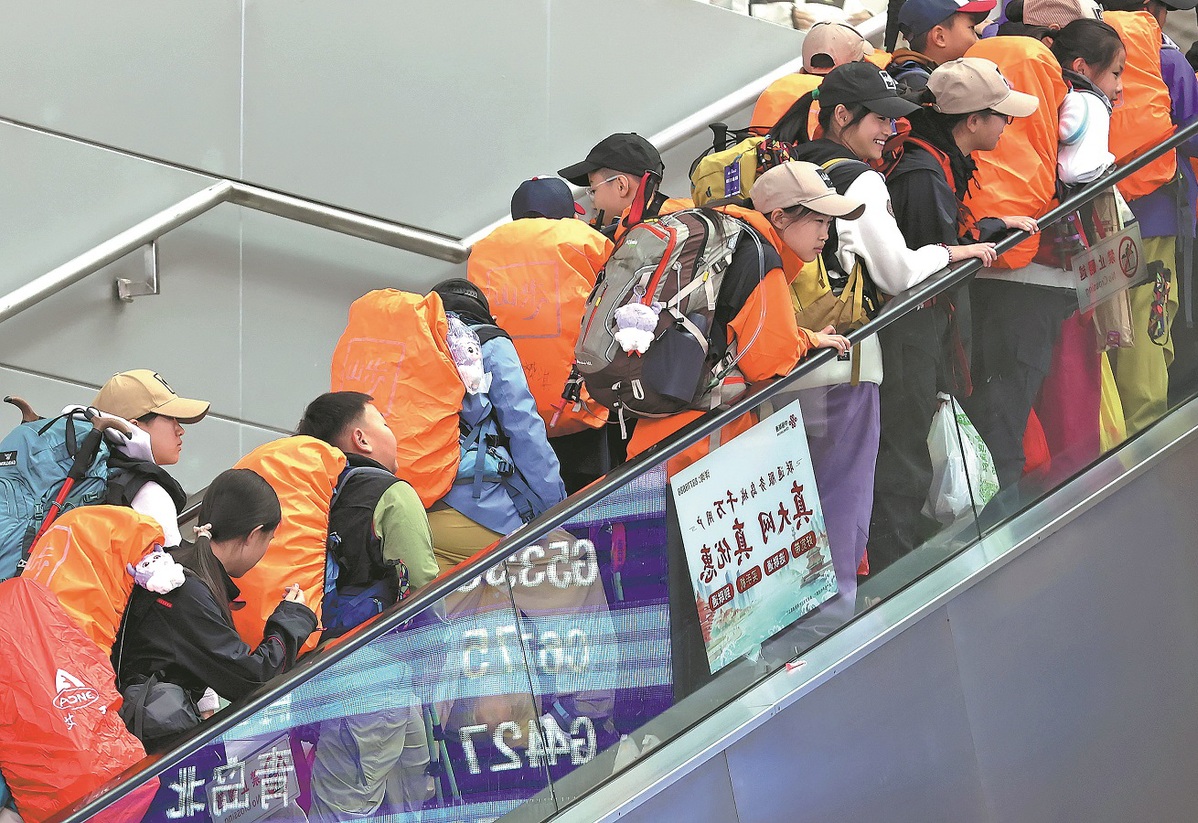
Schoolchildren travel during the autumn break at Qingdao North Railway Station in Shandong province on Thursday. As the city's first autumn school holiday gets underway, railway stations across Qingdao are seeing more young passengers, with November — traditionally a quieter month for tourism — experiencing a noticeable uptick in family travel. WANG BIN/FOR CHINA DAILY
As more regions across China embrace the concept of autumn breaks, families and schools are finding new opportunities to bond and explore, turning these mini-holidays into cherished traditions.
Jiangsu province rolled out the policy for the first time this fall, with Wuxi scheduling its break from Nov 16 to 18, creating a five-day holiday when combined with the weekend.
Other cities in the province followed suit: Nantong set its break for Nov 26 to 30, Suqian for Nov 14 to 18, while cities including Nanjing, Suzhou, Yancheng and Zhenjiang scheduled theirs between October and November.
Further south, Foshan in Guangdong province announced its autumn break for Nov 11 to 13, also forming a five-day mini-holiday with the weekend. In Hunan province, Xiangtan, Yueyang and Yiyang each scheduled three-day breaks in November. Yunnan's Xishuangbanna arranged its break for Nov 12 to 13, while multiple cities in the Inner Mongolia autonomous region set breaks in late November and early December.
The expansion follows a series of policy signals from the central government. In March, the general offices of the Communist Party of China Central Committee and the State Council, China's Cabinet, issued a guideline that explicitly encouraged localities to explore establishing spring and autumn breaks for primary and secondary schools.
In September, nine ministries, including the Ministry of Commerce further reinforced this direction in a separate guideline to encourage the practice.
Nowhere is the autumn break more deeply embedded than in Hangzhou, Zhejiang province.
Tian Bingbing, Party secretary of the Hangzhou Chunhui Primary School Education Group, describes the autumn break as "a perfectly timed buffer in the semester".
After two months of adjustment and study, students often experience physical and mental fatigue — the break offers a chance to adjust and relieve stress.
"It's ideal for students to explore nature, engage in walking study tours, farm experiences and city explorations," she said. The flexible time gives families the possibility to travel off-peak, rest and recharge, and broaden their horizons, she said.
Xu Zhenyu, a big data manager and father of a third-grader at Hangzhou Xixing Experimental Primary School, said his family fully supports the policy.
Every autumn break, the family coordinates its schedules for a short trip, or combines it with other holidays for a longer journey, he said.
"It presses pause on our busy work and our child's intense studies, allowing us to fully immerse ourselves in family life and high-quality parent-child time. This has become a new family tradition since our child started school."
This year, Xu's family is planning a weeklong trip to Xishuangbanna, Yunnan province, a dream his son has held since summer.
Wang Yahan, a teacher at a primary school in Changsha, Hunan province, who is also a parent, sees the break as beneficial for both students and teachers. However, she hopes the autumn break won't be connected to other holidays — because then there are still too many travelers, and the experience isn't as good. "I hope it's a stand-alone break, so we can travel off-peak," she said.
Li Pengbo, Party secretary of the School of Tourism Sciences at Beijing International Studies University and a professor at the school, said spring and autumn breaks alleviate the structural imbalance between peak and off-peak seasons — creating two new "secondary peaks" that smooth out the annual flow of tourists.
Moreover, the breaks stimulate the supply of differentiated tourism products: spring and autumn each offer distinct experiences like flower viewing, study tours, rural experiences and leaf-peeping, which are often overshadowed by family reunion travel during traditional holidays, Li said.
They also cultivate new growth points in family consumption: a child's trip often drives the entire family's spending on transportation, accommodation, dining and cultural experiences.
"The ultimate direction of holiday system optimization should be to give every family more freedom to choose when they travel," Li said. "In this sense, the spring and autumn break system is a necessary step toward a 'people-oriented' allocation of holiday time."
 Editor:Cai Xiaohui


