

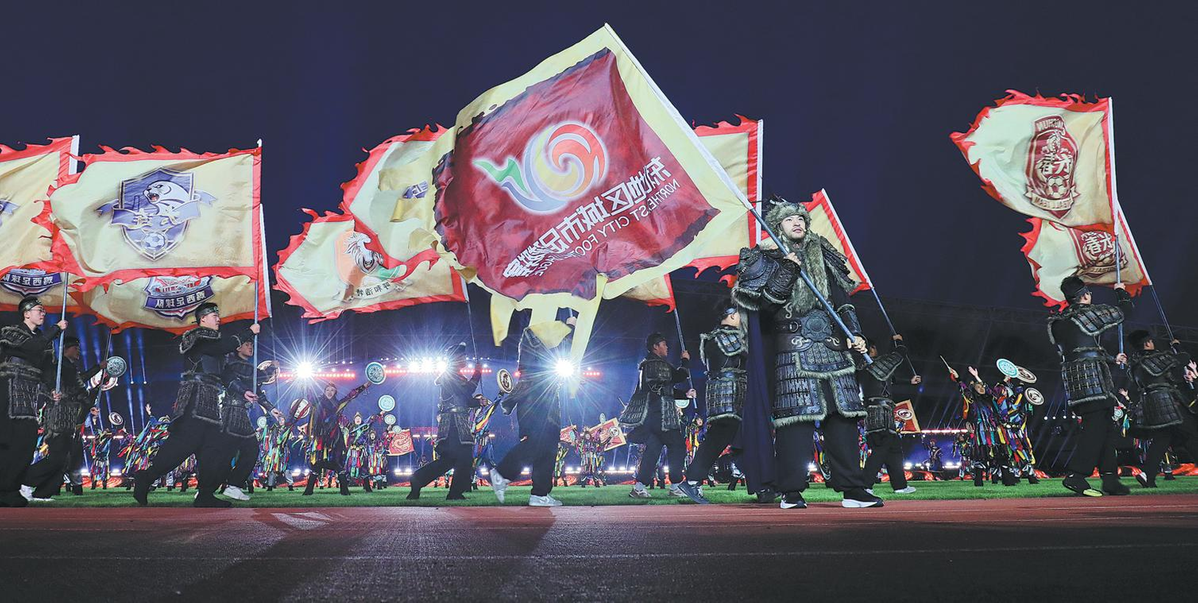
Winter Olympics speed-skating champion Ning Zhongyan (front), clad in traditional-style armor, raises the ceremonial flag at the opening of a regional soccer event in Harbin, Heilongjiang province, on May 23. ZHANG SHU/FOR CHINA DAILY
Across China, grassroots sporting events are emerging as powerful new engines reshaping local economies, though transforming internet traffic volume into sustainable growth remains a critical challenge for host cities, counties and villages.
Driven by the recently issued new Five-Year Plan (2026-30) to promote sports development, grassroots sports are experiencing an unprecedented boom. The plan explicitly encourages initiatives such as "traveling for sports" and "savoring local cuisine while enjoying thrilling matches".
The national blueprint aims to leverage urban soccer and basketball leagues while supporting rural events like the Village Super League and Village BA to facilitate urban-rural integration and rural vitalization.
Following sporting events has become a preferred travel choice, igniting public enthusiasm. However, while some events generate sustainable revenue, others fade into obscurity.
Some cities frequently change their sporting focus, thus failing to establish an enduring brand effect. The pressing question is how to implement strategic design and transform massive internet traffic into sustainable economic growth.
All across the country, grassroots soccer leagues bearing the "Super" moniker are being fiercely contested. On July 4, a Northeast Super League match between Changchun, Jilin province, and Hohhot, Inner Mongolia autonomous region, packed the stadium with over 30,000 passionate fans.
Unlike professional tournaments, these games' appeal lies in a pure grassroots foundation. Over a five-month season, eight city teams and 390 grassroots players will engage in 34 matches.
Meanwhile, in East China, Jiangxi province's Gan Super League saw Jiujiang defeat Fuzhou, Fujian province, 4-0 amid raucous support from fans braving the rain to electrify Jiujiang Stadium.
Among these provincial leagues, Jiangsu's Su Super League boasts the most mature operational system. This year's opening match attracted over 40,000 spectators.
Changzhou, Jiangsu, a key host, has capitalized on the concept of "a single ticket", transforming the act of watching a game into a comprehensive consumption chain covering dining, accommodation, transportation, tourism, shopping and entertainment.
Adjacent to the stadium, Changzhou China Dinosaur Park has ingeniously integrated its intellectual property with the matches. Transitioning from watching the game to touring the park and purchasing themed cultural products has become a common consumer ritual.
Host cities have also broken spatial boundaries between venues and commercial districts, establishing fan zones for live broadcasts and offering exclusive citywide discounts for ticket holders.
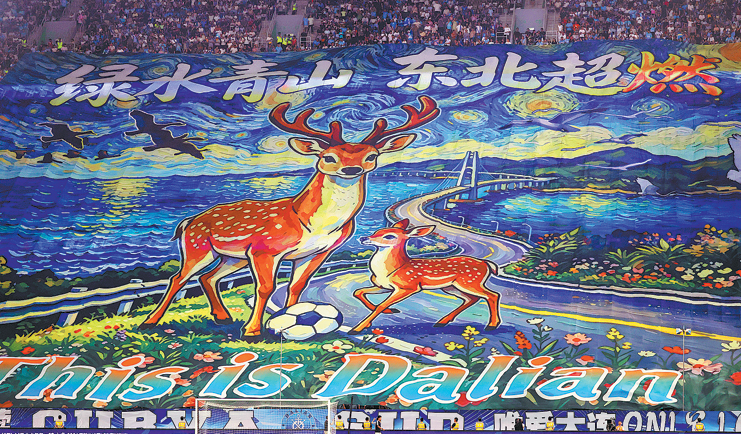
A giant tifo, a huge banner covering the stands, is unfurled in the stadium at Suoyuwan Football Stadium in Dalian, Liaoning province, on Aug 15. HAN HE/XINHUA
During the 2025 season, the Su Super League achieved a remarkable spillover effect — every yuan spent on a ticket drove a 7.3-fold return in peripheral consumption. In Changzhou alone, six home games generated a visitor flow of over 2 million, directly stimulating consumption exceeding 1.5 billion yuan ($223.2 million).
The core strategy involves treating the event as an engine and using supportive policies to channel traffic into diverse consumer sectors.
"Expanding the event space from inside the stadium to the broader urban space creates a massive economic pull. This integrated 'tour, shop and entertain' consumption has a highly evident stimulating effect," said Wang Xueli, director of the center for development of sports industry at Tsinghua University's School of Economics and Management.
While Jiangsu uses tickets to drive citywide spending, Zhejiang province has taken a different approach with its mass sporting event — the Zhe BA.
By reaching every county, the tournament spans 90 counties and districts, allowing rural areas to capture significant traffic and driving the cultural and tourism market deeper into grassroots communities.
This year's provincial opening match took place in Cangnan county. In preparation, Cangnan upgraded over 80 public basketball courts.
A newly constructed air-dome basketball court in Waterfront Sports Park immediately attracted large crowds. Relying on air pressure to support its flexible membrane, the facility boasts a space utilization rate approaching 100 percent.
The immense popularity of the Zhe BA has activated peripheral consumption sectors, with basketball training, equipment sales, catering, accommodation and rural tourism all witnessing substantial growth.
In Changxing county, a growing number of students are receiving systematic training. Since the start of summer vacation, just one basketball training institution alone in Changxing has seen a daily average of over 800 trainees, thus operating at full capacity.
Data show the Zhe BA cumulatively drove 2.92 billion yuan in cultural, commercial, tourism and sports spending in 2025.
Dai Bin, director of the China Tourism Academy, highlighted the necessary conditions for this success: "First, once traffic arrives at a destination, it is crucial to have high-quality lifestyle amenities, cultural spaces and tourism attractions to accommodate it. Second, there must be corresponding transportation infrastructure for rapid access. With these elements, the economic and social momentum brought by an event is incredibly robust."
Jingshan, a county-level city in Hubei province's Jingmen with a population of less than 600,000, hosts more than 40 domestic and international tennis tournaments annually.
On May 24, the ITF World Tennis Tour Juniors J30 Jingshan got underway. Designed for participants under 18, it serves as a key stepping stone for Grand Slam tourneys and attracted 107 athletes from nine countries.
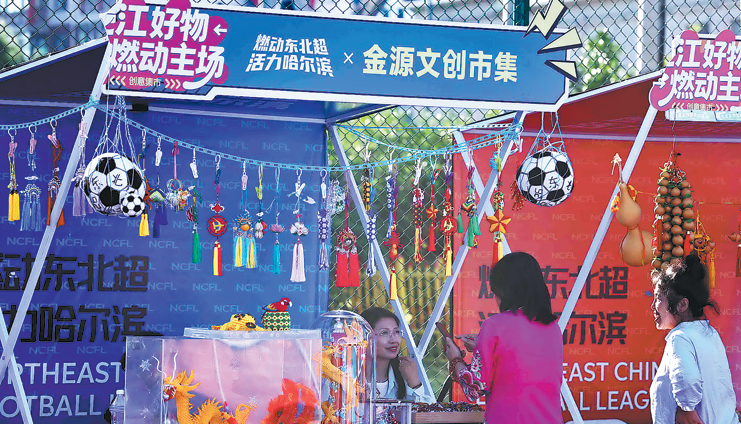
Visitors inquire about information at a sports-themed cultural-creative market in Harbin, Heilongjiang province, in August. ZHANG SHU/FOR CHINA DAILY
In Jingshan, hosting events follows a meticulously planned calendar. International, national and homegrown signature events form a three-tier matrix: international events elevate the city's profile, professional events attract traffic and homegrown events solidify the foundation.
This layout is the result of decades of continuous accumulation. Currently, the city boasts over 100,000 tennis enthusiasts and 356 high-standard courts, averaging 5.67 courts per 10,000 people — ranking first among all comparable Chinese localities.
Beyond hosting tournaments, Jingshan promotes tennis via its educational system. Hubei Provincial Tennis School pioneered a joint management model between provincial authorities, the local county and the school.
Students cultivated through this system have secured 21 gold medals in international youth competitions and 293 in national tourneys.
The thriving industry has given rise to a new profession: "tennis principals", which are individuals engaged in managing tennis clubs, bed-and-breakfasts and equipment services. The industry directly employs approximately 3,000 people and provides indirect employment for 10,000.
"The core of the 'Jingshan Model' lies in respecting the natural development of the sport and its industry. It ensures the formation of a virtuous cycle of development," Wang said.
It is precisely because of this continuous, long-term and systematic dedication — supported by diverse consumer offerings and unique cultural heritage — that these cities can firmly capture internet traffic and transform it into lasting economic gains.
"Whether it be Jingshan or the Su Super League, they all rely on their own resource endowments, tap into their unique cultural characteristics and adapt to local conditions. Only such a path can ensure steady and long-term progress," Dai said.
Wang echoed this sentiment, warning against blind imitation.
"An event wildly popular in one place will not necessarily be welcomed in another. It is imperative to base initiatives on genuine local resource endowments. Behind this success is a commitment to long-term, persistent efforts," she said.
renqi@chinadaily.com.cn
 Editor:Gao Weiyi

