

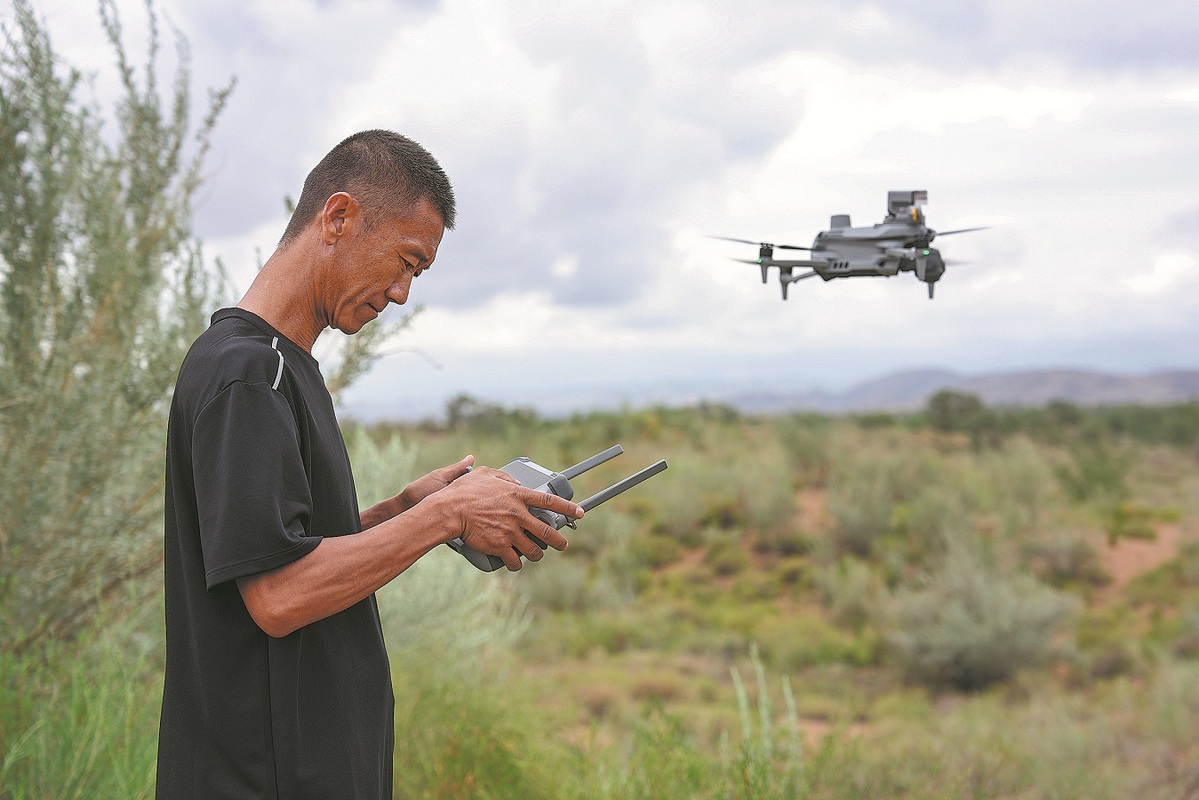
Desert-control worker Guo Xi controls a patrol drone at the Babusha Forest Farm in Gulang county, Gansu province, on Aug 11. LANG BINGBING/XINHUA
At Babusha Forest Farm on the southern edge of the Tengger Desert in Gulang county, Gansu province, 41-year-old Guo Xi can now use a drone to patrol 5,000 hectares of farmland for fire risks and pests, a once laborious task his grandfather's generation did on foot.
The transformation is just as striking when it comes to irrigation.
"My grandfather's generation hauled water on donkey carts, my uncles switched to farm vehicles, and by our generation we had 15-metric-ton water trucks. Now we have drip irrigation," said Guo, a third-generation desert-control worker whose grandfather, Guo Chaoming, was one of the founders of the farm.
Water trucks once struggled to reach remote stretches of sand. Today, Guo said, smart drip-irrigation systems can be managed remotely, making water delivery more precise and efficient.
"Desert control today is no longer simply about hard physical labor. We have to use technology to make desert control and forest management more efficient," he said.
Guo has observed the transformation since childhood.
"When I was young, wherever you looked, there was yellow sand," he said. "Now, wherever you look, it is green. The previous two generations worked for decades to leave us this oasis."
Now a father of three, Guo hopes one of his children will eventually return to Babusha after receiving a good education.
"I hope the next generation can use more professional and advanced technology to protect Babusha," he said.
The generational relay began in 1981, when six villagers from Tumen township — Guo Chaoming, He Falin, Shi Man, Luo Yuankui, Cheng Hai and Zhang Runyuan — all aged 50 or older, banded together to manage 5,000 hectares of shifting sand. They began planting trees and stabilizing dunes as desertification crept closer to villages and farmland.
As the original founders aged, their children took up the mantle. Guo Wangang, Communist Party of China secretary and head of Babusha Forest Farm, stepped in as a second-generation worker to continue his father Guo Chaoming's work.
For Guo Wangang, now 74, carrying on his father's legacy requires persistence.
"The most valuable thing in desert control is perseverance," he said. In summer, he still gets up at 5 am to arrange the day's irrigation and forest maintenance.
"There is a saying in desert afforestation: one part planting, nine parts tending," he said. "Planting a tree is only the beginning. What matters more is keeping it alive over the long term."
Since 2019, Babusha Forest Farm has completed desert control and afforestation on 13,900 hectares and restored about 10,587 hectares of degraded forest, according to local authorities. Vegetation coverage in the front-line areas under its management has exceeded 70 percent, forming a green windbreak about 10 kilometers from north to south and 8 km from east to west.
Water remains one of the farm's biggest challenges.
"A big tree takes decades to grow. Without water, it can disappear just like that," said Guo Wangang, gesturing with his hand.
In 2024, as a deputy to the municipal people's congress, Guo Wangang submitted a motion to address Babusha's water shortage. To resolve the issue, a 500,000-cubic-meter reservoir was constructed alongside an accompanying drip-irrigation network, ensuring a stable water supply source for the entire forest farm.
"One of the biggest worries on my mind has finally been lifted," he said. "The survival of the trees now has a fundamental guarantee."
The forest farm's progress is also reflected in the lives of the people who have worked there.
Reflecting on decades of labor, He Zhongqiang, another second-generation desert-control worker, said the work has brought a deep sense of fulfillment.
A severe sandstorm had earlier convinced him and his peers that controlling desertification on Babusha's original 5,000 hectares was not enough. They also needed to tackle surrounding sources of sand, he said.
They later expanded treatment to another 7,600 hectares of desertified land and, from 2003, spent a decade carrying out desert-control work around Wudaogou village.
"Seeing the land improve and people's lives become more secure makes all the hardship worthwhile," he said.
Ma Shengrong, a forest ranger at the farm, remembers how wind and sand once threatened local harvests.
"When I was a child, crops we had worked hard to plant were often buried in the sand or destroyed by strong winds, and a whole year's harvest could be lost," Ma said. "That no longer happens."
Another witness to Babusha's transformation is Liu Wancheng, 57, who joined the farm in 1991 after moving from the mountainous southern part of Gulang.
"It used to be 'sand advances, people retreat'. Now it is 'people advance, sand retreats'," Liu said. "When I first arrived, I earned just over 40 yuan ($5.93) a month. Now I can make more than 50,000 yuan a year through farm wages, seasonal desert control, and harvesting cistanche."
"We have not only brought the sand under control — but people can also earn an income from it," he said, adding that watching the desert turn green gives him a deep sense of achievement.
Today, Babusha's green economy goes far beyond individual harvesting. A free-range chicken farm sells more than 10,000 birds annually, generating more than 1.2 million yuan in output, while six Babusha-branded products — including cattle, sheep, goji berries and vegetables — are helping expand local agricultural industries.
For Wang Jiguo, deputy director of Gulang county's forestry technology center and a senior engineer, Babusha's core lesson is that desertification control must respect natural laws and local conditions.
"First make the land green, then help people prosper," Wang said, emphasizing that long-term restoration requires giving local people a direct stake in protecting the environment.
What species to plant and how to develop supporting industries, he noted, must be tailored to local soil, rainfall and climate.
"Restoring desertified land is not a short-term project," Wang said. "It demands a long-term commitment so that ecological protection becomes a mission passed from one generation to the next."
Offering a broader legal guarantee for such generational efforts, China's Ecological and Environmental Code, which took effect on Saturday, includes a dedicated section on desertification prevention and control.
Tong Yunshan contributed to this story.
 Editor:Cai Xiaohui

