

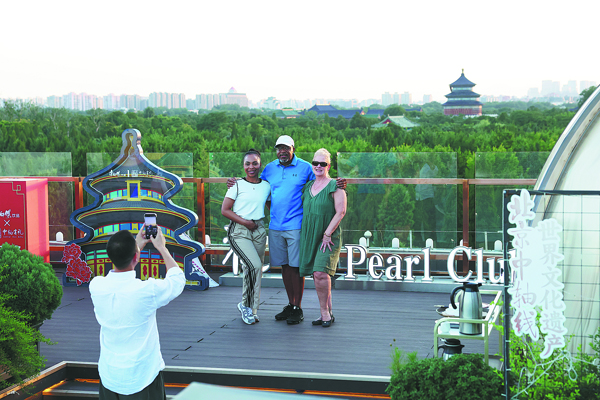
Foreign tourists pose for photos on the rooftop of Pearl Club in Beijing on July 15, with the Temple of Heaven in the distance. [Photo by Zou Hong/China Daily]
Many first-time visitors come to Beijing looking for its famous landmarks. Some leave captivated instead by the rooftops they discovered.
That was exactly the case for Nancy Nielsen, a teacher from Michigan in the United States. While visiting the Pearl Market last year, she noticed another floor above the building. Curiosity drew her upstairs, where she found herself gazing out at the Temple of Heaven.
"It was just so beautiful," she recalled.
She has since returned at least five times, bringing friends back with her this summer to share the view.
Like Nielsen, a growing number of visitors are discovering a different view of Beijing — a bird's eye one.
Following the inscription of Beijing Central Axis on UNESCO's World Heritage list in 2024, Dongcheng district launched the Breeze Terrace Project to bring heritage closer to everyday life.
More than 70 selected rooftops now offer new public spaces above the old city, preserving its historical streetscape while opening up fresh perspectives.
The terraces invite visitors to explore not only the landmarks, but also surrounding neighborhoods, cafes and shops, and do so at a more leisurely pace.
That slower rhythm is exactly what Ming Jing, general manager of the rooftop Pearl Club at the Pearl Market, hopes visitors will find on the terrace, where Nielsen first stumbled upon Beijing's bird's-eye views.
Many visitors arrive after touring the Temple of Heaven. Instead of rushing to the next attraction, they order coffee or a special, thematically shaped mousse cake, waiting for sunset to watch the light shift over the centuries-old complex, he said.
That broader perspective also shaped the first impression of Beijing for Leilani and David from Perth, Australia.
Having only just arrived in the capital, they skipped the usual tourist trail and instead headed to Gui Temple, a rooftop restaurant atop the western hall of the 700-year-old Hong'en Temple near the Bell and Drum towers.
Leilani had expected a bustling metropolis, but was surprised by the slower pace of life in the ancient hutong.
"I imagined it would be much busier," she said. "But it was very calm."
The rooftop felt surprisingly familiar. David said outdoor dining is part of everyday life in Australia, and the relaxed atmosphere made it all the easier to savor Beijing's famous Peking duck.
For Wan Yulin, general manager of Gui Temple, that panoramic view is exactly what makes the rooftop special.
"What they see is not one building," Wan said. "They see everyday life and the passage of time — the past and present."
For some residents and long-term dwellers in Beijing, the broader view has also changed the way they see their own city.
Zeng Leixiao, a doctoral student at Renmin University of China who has lived in Beijing for years, discovered Pearl Club online while searching for fresh angles to photograph the city.
For Zeng, it was less about finding another photo spot than rediscovering a familiar city from a different perspective. Now, rooftop viewpoints are among the first places he recommends to visiting friends.
At Jinbao Place Shopping Center, a 1,600-square-meter rooftop garden has become a gathering place where office workers exercise after work, families tend vegetables at an urban farm and residents join seasonal activities, ranging from moon-viewing evenings to yoga classes.
General manager Wang Chunyan said the rooftop offers something increasingly rare in the heart of Beijing: space.
"At street level, you're surrounded by buildings," she said. "But once you come up here, the whole city opens up before you. Your view stretches across the skyline, and your mood changes with it.
"It's also a place where people can get closer to nature and take a break from the pace of city life," Wang added.
For Han Wei, deputy director of Dongcheng's culture and tourism promotion bureau, the project reflects changing expectations among visitors and residents.
"People no longer want to see only a landmark," he said. "They want to experience the neighborhood around it and spend time there."
Yang Cheng contributed to this story.
 Editor:Cai Xiaohui

