

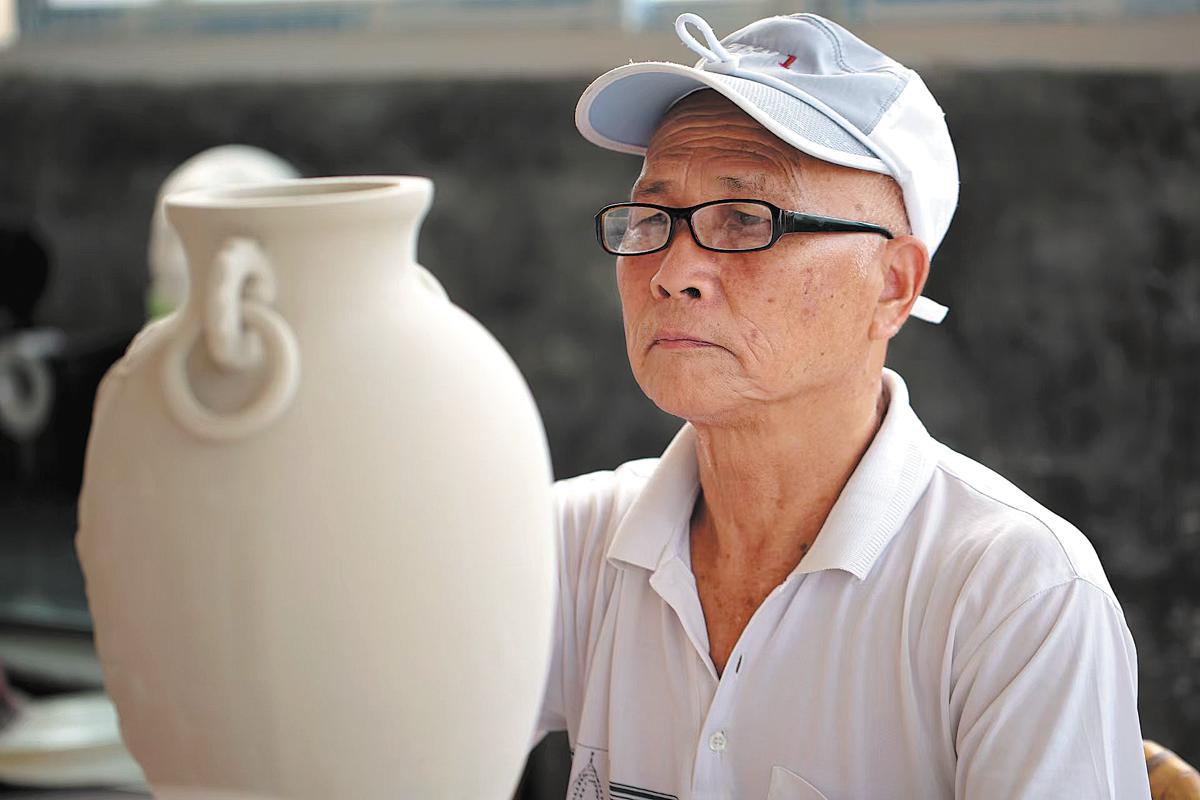
Ceramic master Kou Fuping works in his studio in Quanzhou, Fujian province. CHINA DAILY
At 88, ceramic master Kou Fuping still works daily in his studio in Quanzhou, Fujian province, driven by a lifelong dedication to preserving Jianbai porcelain. The legendary craft, praised globally as "Blanc de Chine", or white porcelain from China, was lost to history for around 300 years before Kou and his team successfully revived it.
Demonstrating the contemporary acclaim of this revived heritage, three of Kou's signature vessels — the Plantain Leaf Vase, Ram's Head Vase, and Peony Vase — gained prominence over the years as prestigious state gifts presented by Chinese leaders during milestone overseas visits.
To achieve the exquisite perfection required for this once-lost legacy, Kou once carried out 13 separate kiln firings before obtaining a single flawless piece. This relentless pursuit of perfection has sustained his ceramic career over seven decades.
Born in 1938 in Dehua county — home to key kiln sites inscribed under Quanzhou's UNESCO World Heritage property representing the Song and Yuan dynasties (960-1368) — Kou developed an early fascination with the local art form that would later shape the trajectory of his life.
As a schoolboy, he collected Dehua clay to fashion handmade brush rests, firing them in rice husk ash as gifts for classmates. This early experience provided him with a profound sense of personal accomplishment.
"I thought right then that I would pursue this as my lifelong career when I grew up," Kou said.
His raw talent shone brightly at 18 when he topped a regional exam for the prestigious Jingdezhen Ceramic Institute in Jiangxi province.
After graduating in 1959, Kou began his career at Fujian's ceramics research department. There, his team was tasked with recreating Dehua's historic, jade-like "ivory white" porcelain ware.
Mastering artistry
Jianbai porcelain is naturally celebrated for being warm, translucent, and as smooth as fine jade. A unique feature is its diaphanous quality; its luminous, ivory-like tone under standard light shifts to a warm, creamy yellowish-white when illuminated from within.
Production of this unique ceramic style gradually faced challenges and became less common from the mid-to-late Qing Dynasty (1644-1911) onward, as blue-and-white ware gained widespread popularity across domestic and international markets.
To unlock its precise formulas, Kou delved deeply into local ceramic history. He traced the craft's evolutionary timeline, which budded during the Song and Yuan dynasties and eventually peaked during the Ming Dynasty (1368-1644). Centuries ago, Italian traveler Marco Polo visited Dehua and was captivated by its craftsmanship. A classical Dehua porcelain jar preserved at St. Mark's Basilica in Venice dates back to Polo's era, linked directly to his journey to China.
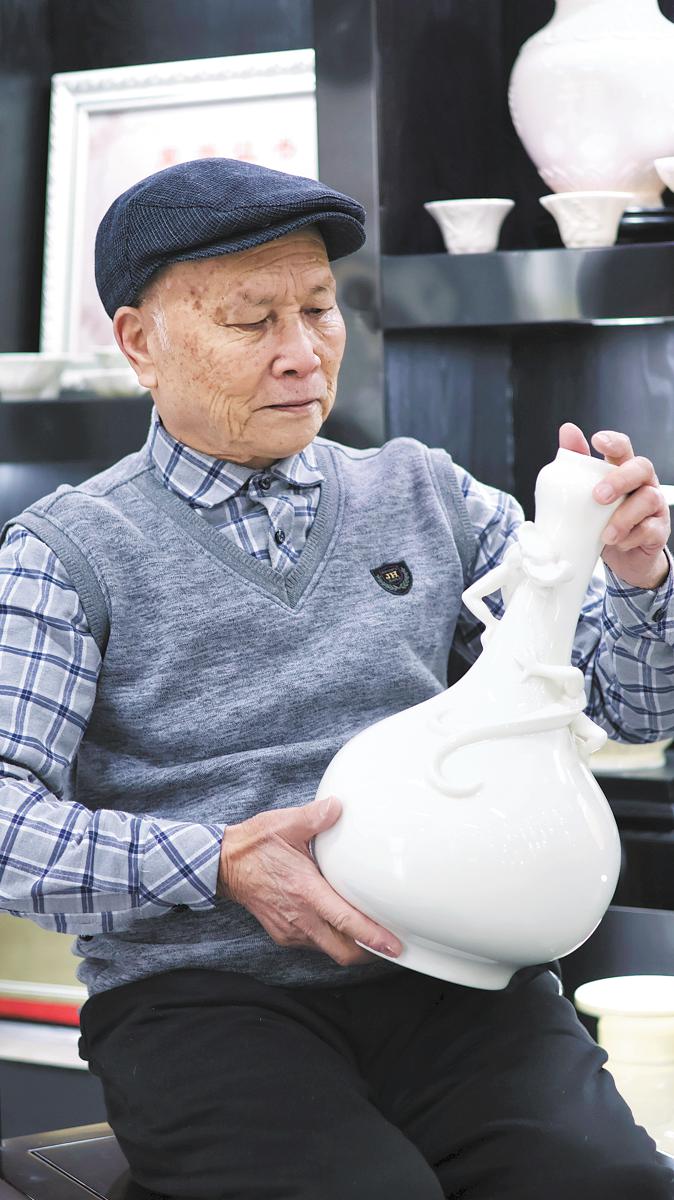
Kou inspects the details of a Jianbai porcelain vase he made in his studio. CHINA DAILY
This ancient artifact represents the very first documented piece of Chinese porcelain to successfully arrive in Europe, and the "ivory white" porcelain became a vital trade commodity along the ancient Maritime Silk Road.
Its restrained forms and luminous glaze appealed deeply to European courtly tastes. Examples quickly entered aristocratic collections across the continent.
This rich history deepened Kou's sense of personal responsibility toward his urgent cultural mission.
Yet Kou and his colleagues faced a massive hurdle — none had ever seen the original porcelain. They scoured ancient Dehua kiln shards for clues, analyzed chemical compositions, searched the region for suitable clay, and repeatedly adjusted the proportions of the raw materials.
"Whatever it took, we had to recreate it," Kou said.
After years of experimentation, the team successfully restored the "ivory white" firing technique in 1963, causing a sensation in the industry.
The revived porcelain was subsequently named Jianbai.
Kou gracefully weaves Chinese culture directly onto the vessels. The plantain leaf symbolizes unity and enduring friendship, the elegant ram represents gentleness and social harmony, while the blossoming peony symbolizes prosperity and perfection.
In 2016, two of his creations were displayed at the World Intellectual Property Organization headquarters in Geneva to showcase Dehua's ceramic copyright achievements.
The luminous vessels left deep impressions on international visitors and were subsequently added to WIPO's permanent collection. "International visitors were deeply impressed when they saw them," Kou said.
Ceramics are not only part of China's cultural heritage, but also an important expression of Chinese civilization, said Kou, adding that he hopes ceramic works with a distinctively Chinese aesthetic will be appreciated by more people around the world.
To better preserve the heritage, at the age of 74, Kou established his own studio, the Fuping Jianbai Porcelain Gallery, where he has worked with his children and grandchildren to keep the craft alive.
"This type of porcelain must be passed on to future generations. We cannot allow it to disappear again," he said.
Ye Ying contributed to this story.
Contact the writers at zhangyi1@chinadaily.com.cn
 Editor:Gao Weiyi

