

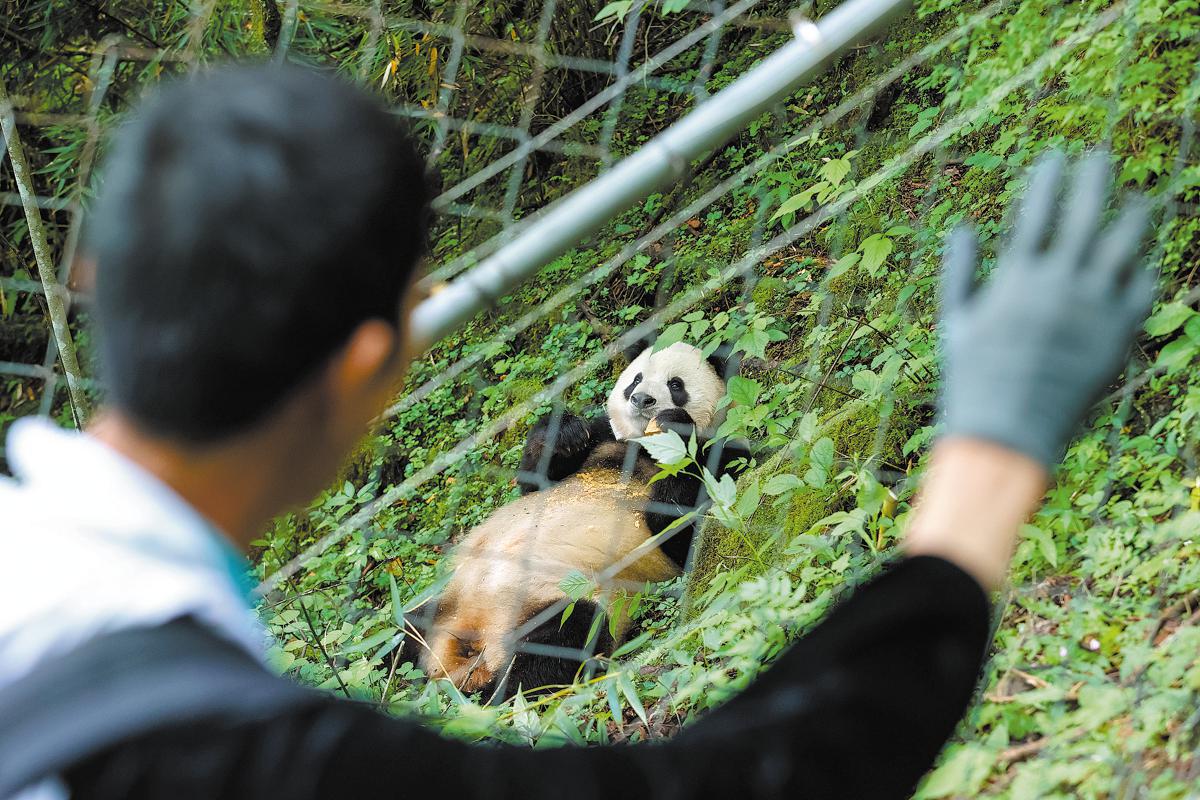
Mu Shijie, a worker from the Wolong section of the Giant Panda National Park, waves goodbye to panda Xian Xian after feeding her during the panda's rewilding training in June 2024. SHEN BOHAN/XINHUA
For nearly a decade, conservationist and giant panda researcher Fu Mingxia has dedicated her life to an animal she has never actually seen in the wild.
Working at the Yingjing management station in Sichuan province's Daxiangling mountain range — a more than 6,000-square-kilometer area twice the size of Yosemite National Park — Fu and her team must rely on the subtle traces the rare animals leave behind.
According to national survey data from 2015, Daxiangling is home to 38 giant pandas.
In a neighboring section of the Giant Panda National Park, which extends into Shaanxi and Gansu provinces, only two of the 12 staff there have ever seen a giant panda in the wild.
Yet Fu's team regularly celebrates what many would consider an odd victory — a fresh pile of spindle-shaped, green-tinged droppings along a mountain trail.
In the early days of her career, which began fresh out of university in 2017, finding these bamboo-fiber traces was a thrilling confirmation of life. Today, it is a routine confirmation of an ecological success.
Fu and her colleagues are convinced that the local ecology has improved significantly in recent years, creating a more hospitable environment not just for giant pandas, but for a wide variety of other wildlife as well.
One visible sign is the increasing frequency of panda droppings along the trails.
Another indicator comes from a network of surveillance cameras installed throughout the forest as the number of images captured has risen steadily, featuring not only pandas but also tufted deer, Lady Amherst's pheasants and other wild animals.
"By 9 am today, our cameras had already recorded 72 detections of mammals and 12 of birds," Fu said in a recent interview. "Since the surveillance network was put into use in October, we have captured over 1,200 video clips or images of giant pandas, including footage of them feeding on bamboo shoots and leading cubs in the wild."
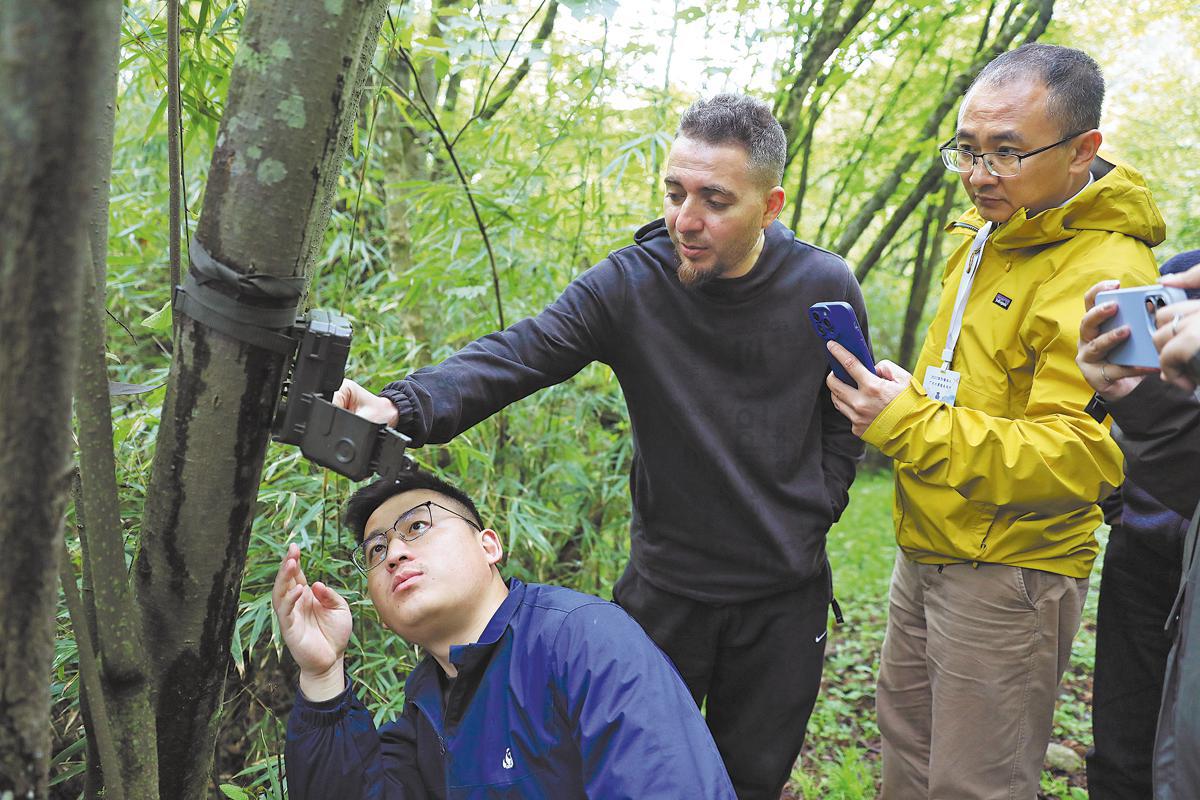
A conservation worker from the national park's Tangjiahe section checks an infrared camera with a media group in May 2023. WANG LEI/CHINA NEWS SERVICE
The Giant Panda National Park, launched in 2021, covers 22,000 sq km, and is home to some 1,340 wild giant pandas, accounting for more than 70 percent of the country's total wild panda population.
Thanks to conservation efforts, including habitat restoration and the reduction of human activities, the integrity and connectivity of giant panda habitats have markedly improved, leading to an increase in the number of pandas observed in the wild, according to authorities.
Monitoring results suggest that populations of other rare animals in the region, such as the golden snub-nosed monkey and the snow leopard, are steadily growing. New plant species have also been discovered in recent years, adding further evidence of ecological improvement.
A key approach to habitat restoration has been the development of bamboo corridors that link isolated forest patches, allowing pandas to move between areas, find food and meet potential mates from other groups.
In Yingjing, the Niba mountain area is crucial for connecting the panda populations in the Daxiangling mountain range with those in the Qionglai mountain range. However, the connecting pathway used to be cut off by a national highway and logging activities.
"An ideal ecosystem for giant pandas consists of an optimal mix of trees, shrubs, bamboo and grass," Fu said. "Bamboo that is too dense impedes their movement, while bamboo that is too sparse forces them to travel long distances to find enough food."
In experimental woodland plots nestled within the forest, Fu and local researchers have been working to determine the right vegetation mix for the panda's habitat. One plot, Fu said, clearly illustrates the contrast between restored and unrestored forest.
Separated by a narrow path, the left side features tall fir trees with thick canopies that block out most sunlight, leaving the forest floor nearly barren. On the right, the vegetation is far more diverse, with sunlight streaming through gaps in the broadleaf foliage and a layered understory of low shrubs and lush bamboo thriving below.
"The difference clearly shows what habitat restoration can achieve," Fu said. "The plantation on the left was commonly established in the region after logging was called off, with little consideration for ecological value. It has low species diversity and offers little benefit to wildlife. It's the type of forest we aim to restore and improve nowadays."

Researchers of the national park track the movements of giant pandas reintroduced into the wild. [Photo provided to CHINA DAILY]
Based on research findings, Fu said that since 2018, local authorities have been clearing tangled vines and undergrowth to create space for selected trees to grow. After replanting native broadleaf saplings, they carry out three years of tending to ensure the trees mature and provide adequate shelter, ultimately achieving a balanced ratio with bamboo and shrubs.
Some 467 hectares of habitat have been restored in the Daxiangling mountain range using this method.
Alongside habitat restoration, researchers have been deploying intelligent systems to aid wildlife surveillance, obtaining more accurate and efficient data to inform conservation efforts.
Fu said the system in Yingjing features hundreds of infrared cameras capable of capturing and analyzing traces of wild animals, covering 90 percent of the target areas.
"The system is powered by data from more than 480 real-time transmission infrared cameras, 200 traditional surveillance cameras, and hydrological and meteorological instruments that track temperature, humidity, wind speed, rainfall and other environmental variables," she said.
"The system has significantly boosted the efficiency of our monitoring work and provides more comprehensive and accurate data on wildlife activity in the region, helping us develop more scientific approaches to ecological protection," she added.
The Baishuijiang section of the national park, located in Longnan city of Gansu province, is equipped with 1,500 infrared cameras, 600 of which are capable of real-time image transmission, according to Kang Yonggang, a local park employee.
"It is estimated that hundreds of videos documenting giant panda movements are recorded each year. Sometimes, at one location, five different giant pandas are captured within a single month," he said.
"The most valuable footage for us is probably images of panda parents strolling with cubs, because it suggests that they are breeding and that the population is stable or even growing," he added.
According to survey data, the panda population in Baishuijiang dropped sharply from 301 in 1974 to 155 in 1984, largely due to large-scale bamboo flowering that caused food shortages. In recent years, the number has remained stable at around 110.
"The comprehensive surveillance system also enables us to monitor climate and ecological conditions in real time," Kang said. "For instance, if bamboo flowering is detected, we will deliver supplemental food to the pandas and plant bamboo species with different flowering cycles at the same elevations to ensure a steady food supply year-round."
Kang said giant pandas are highly protective of their space. "We don't want them showing up near villagers' homes, because that would mean humans are probably encroaching on wildlife habitat. And we certainly don't want any human activities disturbing their normal lives," he said.
"If we do encounter them during patrols in the future, we will keep our distance, quietly observe their condition, and then leave them in peace."
wangxiaoyu@chinadaily.com.cn
 Editor:Gao Weiyi

