

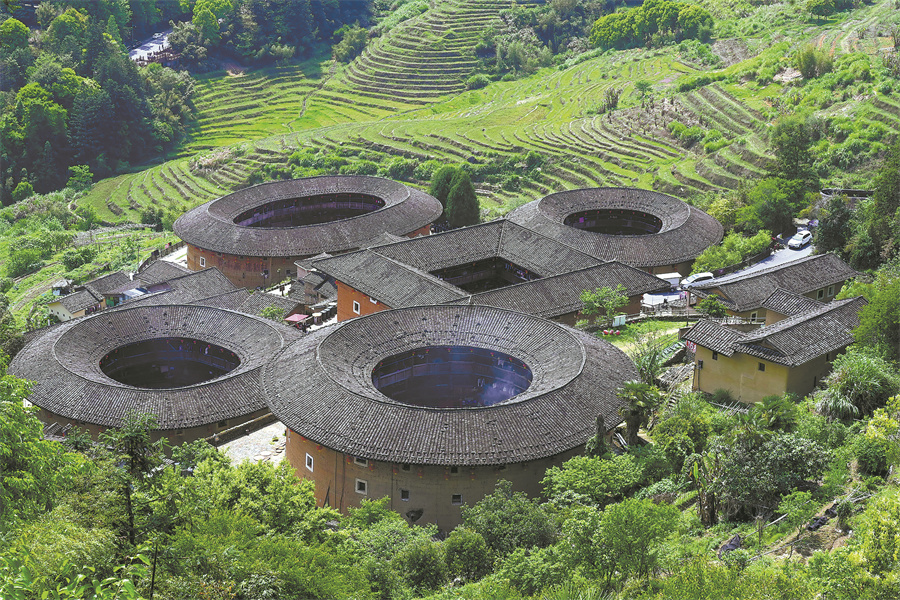
The Tianluokeng tulou cluster in Nanjing county.[Photo provided by Lin Shanchuan/Xinhua]
Driving with her parents from Nanjing, East China's Jiangsu province, a tourist surnamed Ju chose a boutique homestay converted from a traditional tulou, or earthen building, in Zhangzhou city, East China's Fujian province.
"I really wanted to experience what it's like to live in a tulou," Ju says. "It is quiet and unique."
The homestay, named Changrong Building, retains its historical exterior but houses 12 modern rooms. Following a 2023 renovation led by a team from Xiamen University, the structure now features sound insulation, smart home technology, and public reading spaces, offering guests activities such as tea picking and traditional-costume experiences.
Fujian tulou buildings were added to the UNESCO World Heritage List in 2008. In the years following, the local tourism industry shifted from basic sightseeing to high-quality, experiential stays.
Huang Zhihui, secretary-general of the local tulou homestay association, grew up in a tulou cluster. He notes that early homestays lacked professional management and private amenities. Today, however, travelers seek culture and quality.
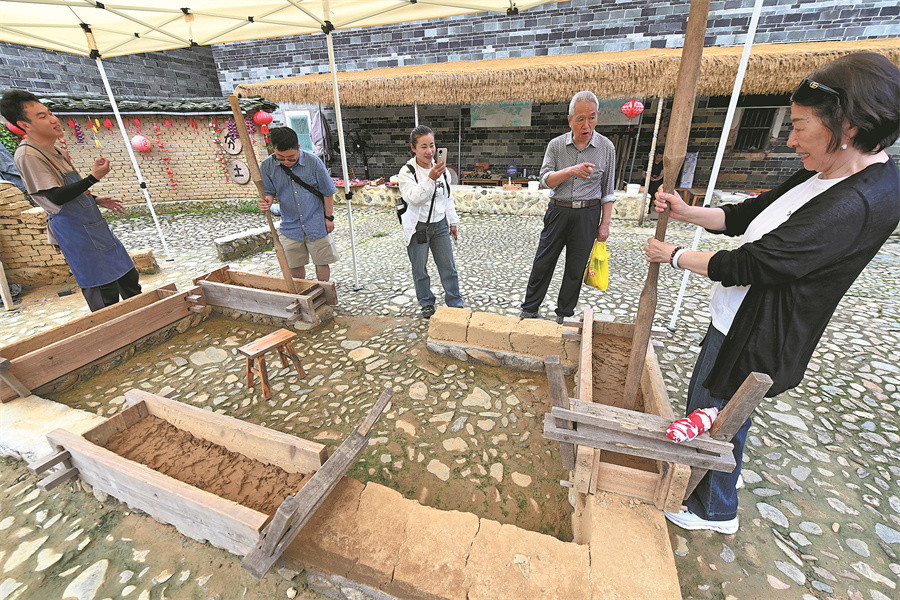
Tourists experience tulou building techniques at a cultural garden in Nanjing county, Fujian province, early this month.[Photo provided by Lin Shanchuan/Xinhua]
Near the well-known Huaiyuan Building, Huang established a market featuring intangible cultural heritage. Since its opening in May 2025, the market has attracted around 700,000 visitors.
To engage younger guests, Huang's team introduced creative gifts such as "sound postcards" and gypsum tulou models embedded with NFC chips, allowing tourists to play their own travel videos by tapping their phones against the souvenir.
The diversification of the tulou economy is also evident in Hua'an county. Traditional houses have been transformed into bamboo art galleries, coffee shops and libraries.
Local authorities are also tapping into modern trends. During this year's Spring Festival, Hua'an launched a China-chic game in which tourists played as characters and interacted with non-player characters to complete tasks involving folk dances and traditional sports.
Data show that during the Spring Festival holiday, the Hua'an scenic area received over 100,000 tourists, with ticket revenue increasing by more than 23 percent year-on-year to over 6.2 million yuan ($907,103). Nighttime visitor flow surged by 73.72 percent, driven by intangible heritage mystery night parades.
"We aim to transform tulou tourism from a half-day trip into a full-day, overnight experience," says Lin Ying, director of the Hua'an Cultural, Sports, and Tourism Bureau.
"Our goal is to move beyond visiting a single building to creating a regional destination where visitors can experience a life that begins with nature and returns to the warmth of the hearth," Lin adds.
 Editor:Gao Weiyi

