


Children take on the thrills of an activity at a forest wellness tourism resort in Bazhong city, southwest China's Sichuan Province. (People/Xia Yu)
China's ecotourism welcomed over 3 billion tourist visits last year, with forest wellness and bird-watching growing increasingly popular, according to a report released recently by the Office of the National Greening Commission.
In spring, flower-viewing tours and outings in nature have become the new highlights of ecotourism.
Many regions have rolled out seasonal offerings to capture the spring travel wave. In mid-March, Shanghai launched its rural spring outing season, releasing 55 recommended countryside routes. Activities range from sightseeing and sipping coffee to picking fruits and vegetables. In the city's Chongming district, residents and visitors can stay at local B&Bs and head out at dawn to the Dongtan Wetland to watch the sunrise and migratory birds along a recommended route.
Hybrid forms pairing ecotourism with hiking or cycling have gained traction. A young woman surnamed Jin often goes hiking. "There's always something waiting around the corner. I once came across tea buds and found wild berries along a reservoir bank. I love that feeling of stumbling onto something surprising," she said. For her, hiking offers more than scenery — it's a chance to stay fit and make new friends.
Industry observers say ecotourism encourages environmental stewardship, promotes sustainable values and fosters harmony between humanity and nature, making it an effective vehicle for unlocking the economic value of local ecological resources. Ecotourism must be developed in tandem with other industries, with ongoing efforts to diversify products, travel routes and immersive experiences in order to broaden its appeal to visitors.
Last winter, birdwatching and photography enthusiasts from across the country flocked to Pinggu district in Beijing to catch sight of the white-tailed eagle, a species under first-class state protection in China. Since the 1990s, the district has recorded the bird species returning to overwinter year after year. The birdwatching boom has boosted tourism spending in areas like catering, accommodation and transport, and helped villagers nearby actively engage in bird protection and offer guiding services.
As curiosity about the natural world grows, so does the call for greater conservation awareness. In recent years, many birdwatching associations have launched public outreach initiatives to protect birds, while nature-themed study tours centered on ornithology and conservation have grown in popularity. In Yancheng, east China's Jiangsu Province, birdwatching enthusiasts and volunteers have taken their classrooms outdoors to the wetlands, helping children scan the horizon with binoculars and learn about the world of migratory birds.
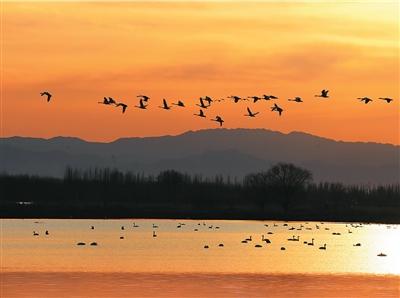
Swans fly over the Guanting Reservoir National Wetland Park in Zhangjiakou city, north China's Hebei Province. (Photo/Sun Huijun)
Plant observation and ecological stewardship experiences have attracted visitors as well. Northwest China's Qinghai Province has tapped the natural assets of Qinghai Lake and the Qilian Mountains to blend nature education with study tours. Cycling along the lakeshore, observing rescued wildlife at rescue stations and learning about the daily routines of ecological rangers at management and protection stations have all proven popular with visitors.
A sound eco-environment is the most basic public good that benefits all. In recent years, ecotourism offerings including forest wellness have built on forest ecosystems to integrate local elements like food, herbal medicine and indigenous culture, giving visitors health and relaxation experiences that translate the gifts of nature into tangible benefits for physical and mental well-being and higher incomes.
As of October 2025, south China's Guangxi Zhuang Autonomous Region had established 38 national-level and 53 autonomous region-level bases of forest wellness, and launched 24 premium routes of forest wellness tourism. In 2024, the forest wellness and ecotourism sectors generated combined revenues of more than 230 billion yuan (about $33.28 billion) for Guangxi.
 Editor:Cai Xiaohui

