

Editor's note: China Daily reporters leverage local expertise to devise diverse itineraries that showcase a blend of historical landmarks and natural wonders in highly recommended cities and sites, offering practical guidance to experience the country.
Beijing refuses to stand still. For centuries, it has layered tradition atop transformation, with dynastic capitals evolving into a modern metropolis, and ancient waterways threading through high-rise canyons. Today, that evolution is picking up speed.
Across the capital, rivers that once sustained imperial grain fleets, then slipped into neglect, are being reclaimed. Their banks, long sealed off or ignored, now draw crowds in search of slower moments: an afternoon coffee by the water, a jog at dusk, a quiet place to sit and watch the light shift on the water. The Liangma River, lined with new cafes and crossed by bridges that have become local landmarks, draws millions of visitors each year. Further east in Tongzhou district, stretches of the Grand Canal have fully reopened, where its broad steps and promenades encourage residents and travelers alike to linger rather than rush.
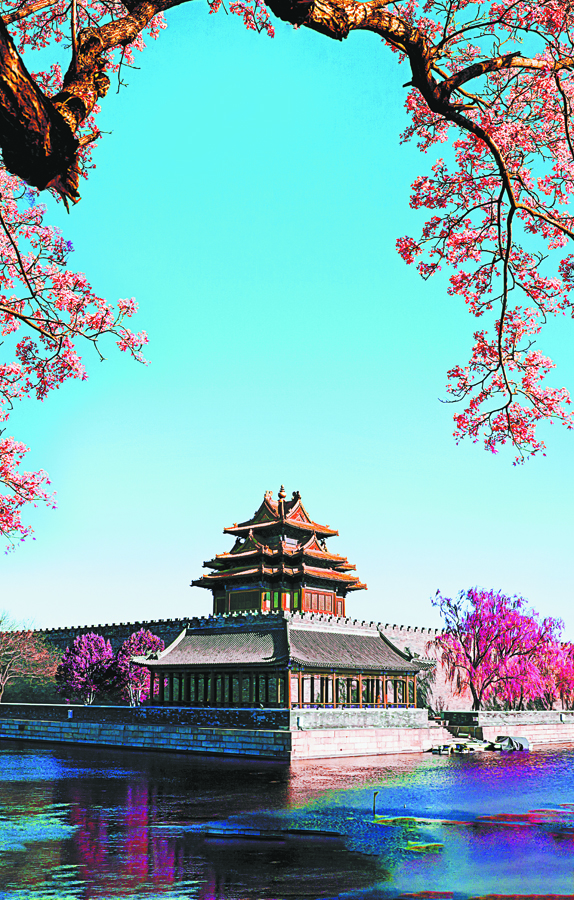
A corner tower of the Forbidden City, an iconic landmark of Beijing's Central Axis, is adorned with blooming flowers in early spring. [Photo provided to China Daily]
Back in the historical core, old districts are finding new rhythms in the warren of hutong (small alleys) flanking the Central Axis. West of this imperial spine, a century-old arcade now anchors a complex where visitors encounter a 22.8-meter-long dragon sculpted entirely from white chocolate. East of the axis, in a temple marketplace that has played a role in many lives, a heritage medicine house pours lattes infused with monk fruit and goji berries beneath restored temple ceilings.
The terrain shifts again in the southern Beijing E-Town area. A mechanical Monkey King greets crowds at a robot emporium, its golden staff swinging in response to approaching visitors. A short drive away, the factory floor of a Chinese automaker pulses with precision: molten aluminum pours into molds, hundreds of robots move in choreographed unison, and a vehicle rolls off the line within minutes.
These different layers of Beijing harmoniously coexist in a way that many other aspects of the city do, with the new atop the old, the fast atop the slow, the futuristic atop the ancient. It is up to visitors to decide which version they would like to explore.
 Editor:Cai Xiaohui

