

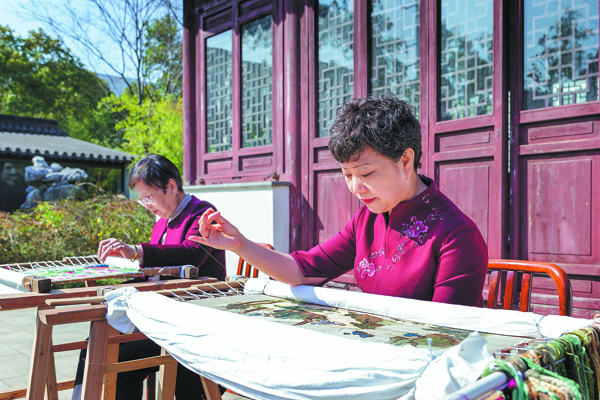
Qi Qiulan (right) and her mother work on embroidery patterns in their workshop in Suzhou, Jiangsu province. [Photo provided to China Daily]
The ornate dragon robes once worn by Chinese emperors are long gone, either buried or locked behind museum glass. But the skills that fashioned them still exist among a select group of experts, including Qi Qiulan from Suzhou, Jiangsu province.
At 62, Qi is a modern link in an unbroken chain of embroidery artisans stretching back to the Ming Dynasty (1368-1644). Her maternal great-grandmother stitched dragon robes for the Forbidden City. Her mother embroidered pillowcases in the 1960s and stitched obi for Japanese export in the 1970s.
Qi herself has dressed world leaders, exhibited at four World Expos and built a business that proves handmade luxury can survive — and even thrive — in an age of machines.
Qi cannot remember a time when she was not surrounded by silk and thread. By age 4, she was sitting at her mother's feet, watching a needle dance through fabric. By age 6, she was doing it herself — mending clothes, embroidering small patterns and absorbing a craft that has flowed through the women in her family for centuries.
"I was born into this. It's in my blood. We call it children's kung fu. The skills you learn when you're young never leave you," she said.
That awareness of extinction shadows everything Qi does.
In 1988, when six months pregnant, she opened a tiny shop in Suzhou. She carried bolts of fabric on her back, squeezed onto buses and sometimes hitchhiked to save money. She often forgot to eat.
That small shop eventually grew into a chain of more than 30 flagship stores, selling products ranging from apparel to home goods. But Qi never stopped thinking about the significance of her calling.
"Silk culture is the wisdom of the Chinese nation. Suzhou embroidery is a national intangible heritage," she said. "This craftsmanship is unique in the world. Silk used to be called soft gold. We have to restore its value, not just in price, but in meaning.
"People today appreciate when a garment is akin to a piece of art. It's about infusing artistic value into everyday life."
Qi's work has dressed world leaders. In 2014, her proposal to use Song brocade was adopted for garments worn by world leaders attending the Asia-Pacific Economic Cooperation meeting in Beijing. In 2016, she crafted an official gift set for first ladies at the G20 Summit in Hangzhou, Zhejiang province.
The scarf for that set combined four embroidery stitches. For a single leaf, more than 10 shades of silk thread were used to create depth and realism.
Qi said she is racing against time to produce more art pieces.
"Young people today don't learn these skills. Twenty years from now, there won't be so many embroiderers," she said.
Suzhou embroidery requires patience. A single silk thread, already thin, can be split into more than 30 strands. The shading is done so carefully that the result looks almost like a painting.
One of Qi's proudest achievements is a 15-meter-long embroidery copy of The Prosperous Suzhou Scroll, a Qing Dynasty (1644-1911) painting depicting the city's 18th-century bustle. Twenty embroiderers worked on it for six and a half years.
"People ask me how much it's worth. I would say priceless. I'm keeping it. It's my dream," she said.
Qi plans to display the piece, along with hundreds of others, in a museum she is building in Suzhou.
"These pieces we leave behind will speak for us," she said.
Qi's expertise has already been passed to the next generation. Her son Xu Ting, a mathematics graduate from the University of Oxford, joined the family business after helping his mother at the 2015 Milan Expo.
"He told me, 'Mom, what we're doing is meaningful. We're spreading Chinese culture,'" Qi recalled, adding: "Life is about spending it doing something you love, and inspiring others to love it too. That is a very happy thing."
For Qi, that happiness is inseparable from a sense of duty. When she stands on international stages, she carries more than samples and business cards.
"When I speak, I speak for all the embroiderers who came before me. I speak for China and the generations of women whose names were never recorded, but whose stitches held a civilization together," she said.
 Editor:Cai Xiaohui

