

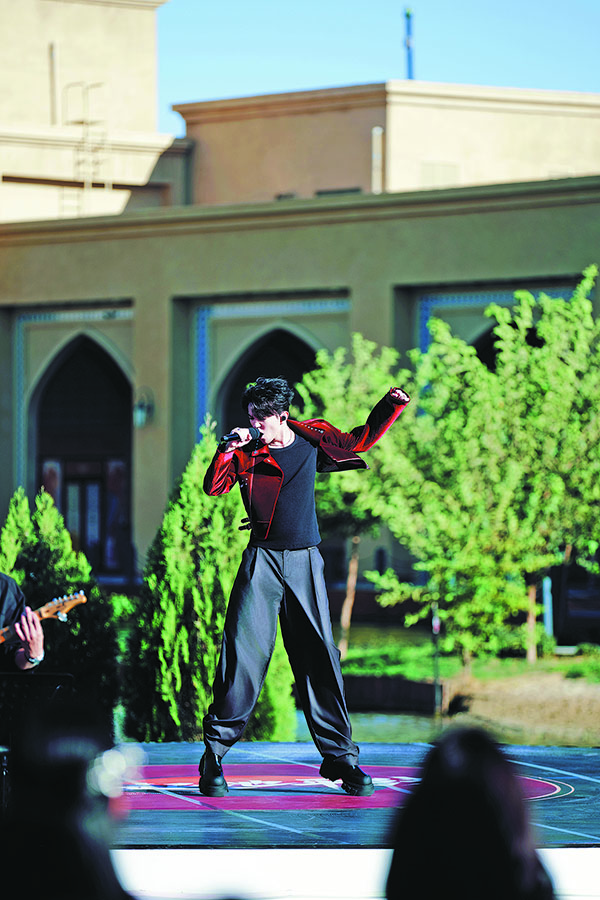
Music program Voice Beyond Horizon traces a creative journey across Kazakhstan with singers from different countries, including Dimash Kudaibergen from Kazakhstan, Stefan Zdravkovic from Serbia, Giulia Falcone from Italy, Jeryl Lee from Malaysia, and Zhang Xiyun from China. [Photo provided to China Daily]
The first time Chinese audiences saw Dimash Kudaibergen on Hunan Satellite TV, he was a 22-year-old singer few people knew.
Standing on the stage of the hit music competition Singer 2017, he performed in a language not his own and poured his heart into every note as he tried to prove himself with his astonishing vocal range and technique.
He finished second, and the rest is history: world tours, songs in multiple languages and a global fan base numbering in the millions.
Now, at 31, the Kazakh singer widely regarded as one of his country's most iconic performers has returned.
This time, however, he's not here to compete. He's here to give back.
Recently, Kudaibergen served as the initiator of Hunan Satellite TV's first China-Kazakhstan co-produced music program, Voice Beyond Horizon.
The program brings together eight young music lovers from China, Kazakhstan, Kyrgyzstan, Serbia, Malaysia, and Italy for a 22-day journey across Kazakhstan, during which they will participate in music competitions and cultural visits.
The program is now being aired on Hunan Satellite TV, beginning on Feb 5.

Music program Voice Beyond Horizon traces a creative journey across Kazakhstan with singers from different countries, including Dimash Kudaibergen from Kazakhstan, Stefan Zdravkovic from Serbia, Giulia Falcone from Italy, Jeryl Lee from Malaysia, and Zhang Xiyun from China. [Photo provided to China Daily]
Along the way, they visited Turkistan, Aktau, Almaty, and Astana for cultural immersion, collaborative music creation, and public performances.
Veteran Chinese singers Lei Jia, Li Yugang, Julia Peng, and Cai Guoqing, alongside renowned American music producer Walter Afanasieff, served as judges for the competition, offering guidance and advice to the eight young participants.
Kudaibergen was fully involved in both the competitions and travel organizing. For him, this project carries a deeper purpose.
"I returned as someone responsible for building a bridge between cultures and our countries," he says.
"Sometimes I was a mentor. Sometimes an older brother. Sometimes just a listener."
He adds that what mattered most was lending a patient ear to the participants' doubts, fears and discoveries.
His supportive approach, he explains, comes from his own experience.
Chinese audiences embraced him warmly when he was still an unknown singer, and now he feels a responsibility to offer that same support to the next generation of talent.
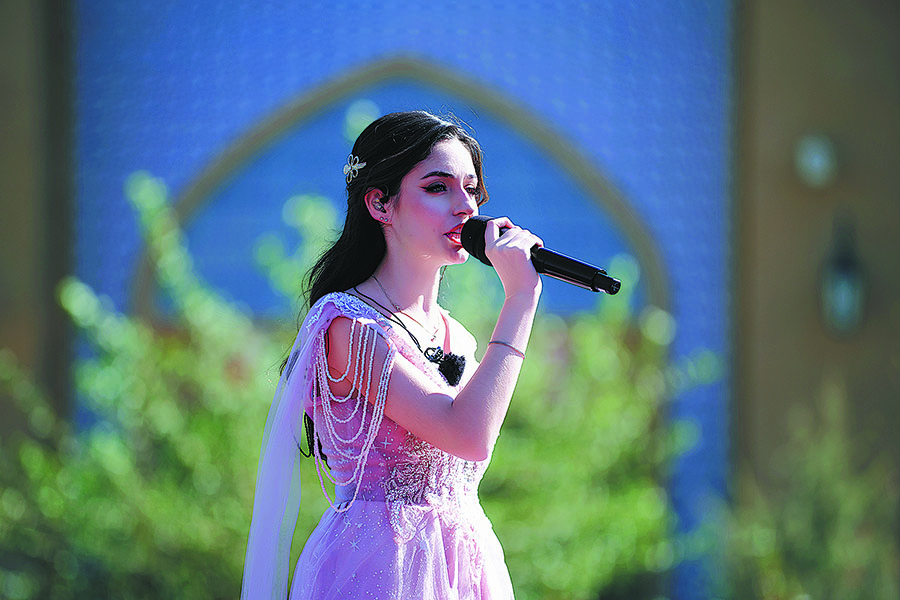
Giulia Falcone from Italy. [Photo provided to China Daily]
During the trip, the young musicians visited local markets, vast grasslands and lakesides. They spoke with residents and explored the stories behind Belt and Road Initiative cooperation projects across Kazakhstan, drawing inspiration for their musical creations.
"Through the show, Kazakhstan was known not as a postcard, but as a living, breathing land with the wind of the steppe, the warmth of its people, and the silence," says Kudaibergen.
Although he has spent much of the past decade traveling the world — estimating that only about 20 percent of that time was in Kazakhstan — the singer says he is now making an effort to stay home more often; he hopes to rediscover inspiration in the culture and landscape that shaped him.
For instance, he mentions the beauty of his mother tongue, which, in his view, is not a vehicle for intense, physical emotion; instead, it demands honesty.
"The Kazakh language is deeply musical by nature. It has space within it. It teaches patterns and respect for silence. If someone plays the dombra (a traditional two-stringed plucked instrument), you immediately picture the grassland, the horses.
"When I sing or write in Kazakh, I feel my connection to the land and my love for our steppes."
"I also wanted the musicians to feel that their roots are not limits, but a source of strength," he says.

Zhang Xiyun. [Photo provided to China Daily]
Zhang Xiyun, a 28-year-old singer-songwriter who wrote several hit guofeng (Chinese-style) singles inspired by traditional Chinese opera, is among the eight participants.
A graduate of the National Academy of Chinese Theatre Arts' Peking Opera performance department, she performed a song on a seaside stage in the port city of Aktau that incorporated authentic, unadulterated Peking Opera vocal techniques.
The performance drew enthusiastic applause from the audience and reassured her that listeners could appreciate a blend of traditional opera singing and contemporary pop.
Kudaibergen, a vocalist she has long admired, acknowledged her talent during the program.
"His encouragement motivates me to learn from different cultures, draw on diverse perspectives, and pursue a future direction as a music producer," she says, adding that the trip has sparked her interest in learning to play the dombra, which she is now studying.
Zhang's path to music began early. She started learning the laodan role (a character type portraying elderly women in Peking Opera) at the age of 10.
Years of strict training and a disciplined lifestyle in an opera troupe taught her to set very high standards for herself.
For a long time, she was quite formal, serious and somewhat reserved.
"After graduating, I started making my own music, and made many new friends who helped me become more cheerful and more willing to show my true self," she says.
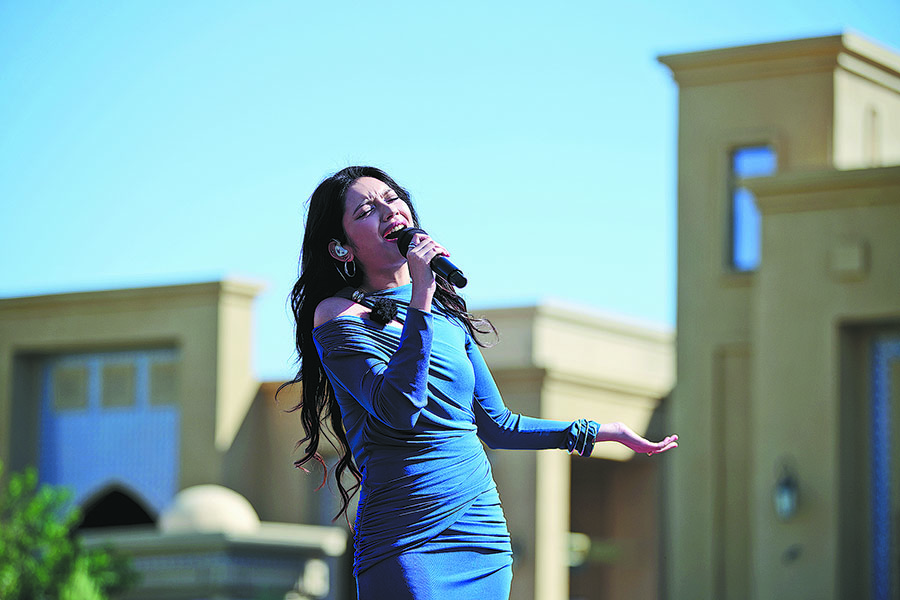
Jeryl Lee. [Photo provided to China Daily]
One of those friends is Jeryl Lee, a 25-year-old singer from Malaysia, who also participated in the program. The two quickly bonded during the journey.
"This program was a relaxing journey for me," says Lee, who appeared very laid-back throughout the show.
"Lee is so different from me. I used to be very tense during performances. But after we worked together on stage, I began to relax more," Zhang says.
Lee, in turn, says she greatly admires Zhang's vocal skills and operatic background, finding her performance style delicate and emotionally compelling.
"The emotional connection between a singer and a song is very important," Lee explains.
She says she hopes that in the future she will be able to create music that reflects her own feelings and experiences rather than simply performing songs written by others.
Growing up in Malaysia's multicultural environment, Lee is multilingual and often served as a translator during the journey.
She also took the opportunity to learn some Kazakh. To her, Kazakh songs feel highly visual and evocative, painting vivid scenes through melody and rhythm.
Reflecting on the journey, Kudaibergen recalls an unforgettable moment when participants from different countries were debating a musical decision.
Suddenly, one of them began softly singing a melody from their homeland.
Another joined in.
Then another.
"The other competitors didn't know about that song, but everyone started singing. They started to freestyle, and it was magical," he recalls.
"I think that moment was not about competition, but about connecting hearts."

Music program Voice Beyond Horizon traces a creative journey across Kazakhstan with singers from different countries, including Dimash Kudaibergen from Kazakhstan, Stefan Zdravkovic from Serbia, Giulia Falcone from Italy, Jeryl Lee from Malaysia, and Zhang Xiyun from China. [Photo provided to China Daily]
 Editor:Cai Xiaohui

