


Village doctor Li Junyi treats a patient in Jianshe village, Dalad Banner, Inner Mongolia autonomous region. [Photo/China Daily]
When the shrill of the emergency alarm cuts through the night, and stretchers race down fluorescent-lit corridors, every second inside the emergency room becomes a sprint against death.
The third season of Chinese Doctors, titled 24 Hours in A&E, recently premiered on China Media Group's CCTV-9 documentary channel and is streaming on major platforms, including Tencent Video, iQiyi, Youku, Bilibili, and Migu Video. The series has earned a 9.7 rating on Tencent Video, reflecting a strong audience response.
Jointly produced by Legend Media and Health News, the documentary moves beyond individual rescue stories to examine the healthcare system that makes them possible. Using emergency medicine as its lens, it traverses regions and institutions to present a cross-sectional portrait of how China's emergency medical network operates across levels and distances around the clock.
At the center of the project is chief director Zhang Jianzhen, a research fellow at the Institute of Journalism and Communication of the Chinese Academy of Social Sciences. She approaches the subject not only as a filmmaker, but as a long-term observer of the country's medical system.
"While filming, I witnessed the solid strength of China's emergency system," Zhang says. "At the same time, I confronted life's unpredictability: a 5-year-old child who suffered a high fall and could not be saved, and a 27-year-old mother in the terminal stage of cancer who passed away before our cameras."
These extremes — quiet systemic success and irretrievable loss — shaped her understanding of emergency medicine. "They are the ones who ignite hope amid uncertainty. The Hippocratic Oath and the duty to save lives have long been internalized as instinct. Through this film, I hope to call on society to offer these guardians of life greater understanding, trust, and tangible support."
For Zhang, medical documentaries must go beyond storytelling. "Hospitals are never short of stories. What matters more is demonstrating the support of the national healthcare system. It is this system that enables medical services to operate efficiently."
"There are already documentaries portraying the emotional lives of ordinary people in hospitals. By focusing on emergency care this season, I hope to show how national capacity safeguards people's lives and health through the operation of the medical system," she adds.
Even the title reflects this intent. "'24 Hours in A&E' is a defining feature of emergency medicine — it never stops. We structured the narrative around a 24-hour cycle to reflect the real conditions of different levels of medical institutions within China's emergency system."
Hospital selection followed a deliberate logic of full-spectrum representation. "I wanted full coverage, from community clinics and village health stations at the grassroots level to county and municipal hospitals, up to provincial hospitals and national medical centers, such as Peking Union Medical College Hospital."
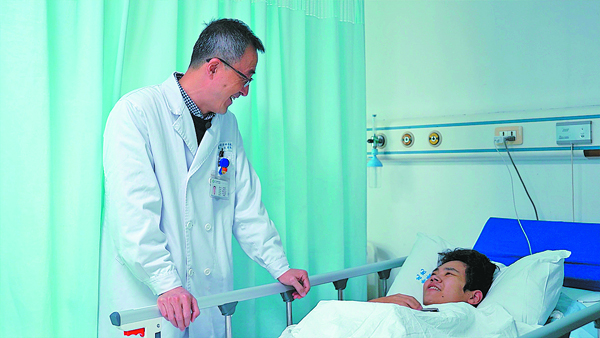
Sun Mingwei, director of the emergency department at Sichuan Provincial People's Hospital in Chengdu, speaks with a patient. [Photo/China Daily]
To achieve that scope, the crew spent 12 months embedded in emergency departments at 10 hospitals nationwide, filming more than 140 days and following the full chain of care from emergency rescue to in-hospital multidisciplinary collaboration.
The result is a sweeping relay of life: a village doctor in the Inner Mongolia autonomous region initiating a "life highway" for a stroke patient; a helicopter in Zhejiang province airlifting a severely injured young man; teams across regions coordinating seamlessly to save patients after high falls. Behind each dramatic moment lies a web of protocols and cooperation that turns "time is life" into practice.
Grassroots village doctors left the deepest impression on Zhang. "They are not only guardians of health, but also providers of emotional comfort. That is crucial."
With the advancement of digital healthcare, their role has become even more pivotal. "We filmed the 'mobile hospital' general practice support package, through which specialists in Beijing and Shanghai can conduct remote consultations. In such cases, village doctors become the indispensable safety net of digital healthcare."
She notes that many villagers are elderly and speak dialects, making village doctors essential intermediaries. "This trust is built over years of interaction. At its core, the doctor-patient relationship is about entrustment — 'I trust you with my life'. Medicine is full of uncertainty, especially in emergencies where patients are on the brink of life and death. Such trust is essential."
In Jianshe village of Dalad Banner in Inner Mongolia, Zhang observed tangible results: Over the past five years, dozens of heart attack patients received timely stent procedures, and remarkably, none died from a heart attack or stroke, which is a testament to both the skills of the village doctors and the strength of the emergency system.
Conveying doctors' professional conviction is central to her work. "It is no exaggeration to compare doctors to soldiers in peacetime. They are the ones who rescue and protect our lives, pulling patients back from the brink of death. Such a profession requires unwavering faith."
She adds: "Doctors must face the possibility of ultimate failure, yet continue working with all their strength. That is its greatness… we must give everything we have; that is what I most want to highlight."
That sense of mission, she says, is often quiet but absolute. "An emergency doctor resting at home may receive a call and rush back to the hospital in pajamas. For them, it is not about showing off; it is a sense of mission."
And much of that mission remains unseen. "Behind every life saved, every diagnosis analyzed, and every solution devised, there is immense effort that patients do not see. We want to reveal that, so ordinary people can better understand and appreciate this profession."
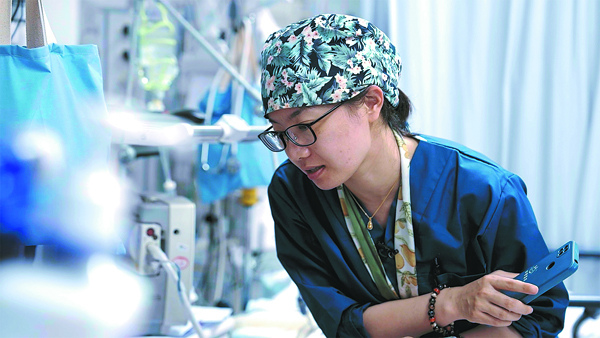
Ma Shicheng, chief duty doctor in the emergency department at Peking Union Medical College Hospital in Beijing, at work. [Photo/China Daily]
Xu Peihai, head of Health News, describes the documentary as a comprehensive examination of the nation's healthcare service system, testing the integrity of tiered diagnosis and treatment, inter-institutional coordination, advanced medical technology in practice, and the professional conviction and humanistic spirit of medical workers.
For Lu Xiao, associate chief physician of the Department of Emergency Medicine at the Second Affiliated Hospital of the Zhejiang University School of Medicine, the series resonates deeply. "I have worked in emergency medicine for 13 years. What we hope to see is not only that patients survive, but that they return to life, family and society."
Recalling a girl who fell from the 20th floor and later recovered to take her high school entrance examination, he says: "That represents the hope created by the emergency department and the selfless dedication of the entire medical team."
He emphasizes: "Emergency rescue is never a one-person battle. I hope this documentary helps people truly understand, appreciate, and respect emergency medicine. That understanding means a great deal to us."
After years immersed in medical documentaries, Zhang's focus is already turning to critical care medicine for a future season. She also plans the overseas distribution of the current series, hoping the world gains a more authentic understanding of China's medical development.
She has also observed a growing trend of foreign patients seeking treatment in China — something she views as a sign of increasing international recognition of the country's healthcare system.
"In today's context, I feel that the documentary offers an authentic portrait of our society," she says. "It tells the stories of ordinary people while presenting the strength and structure of the medical system. I hope it helps the world gain a more grounded understanding of China's healthcare development."
Chinese Doctors: 24 Hours in A&E captures more than moments of crisis. It reveals the infrastructure of response that stands ready long before the alarm sounds.
And when that alarm does cut through the night, what answers it is not just a doctor or a hospital, but a system built to race against time, every hour of every day.

Shi Di (right), associate chief physician in the same department, discusses a patient's condition with colleagues. [Photo/China Daily]
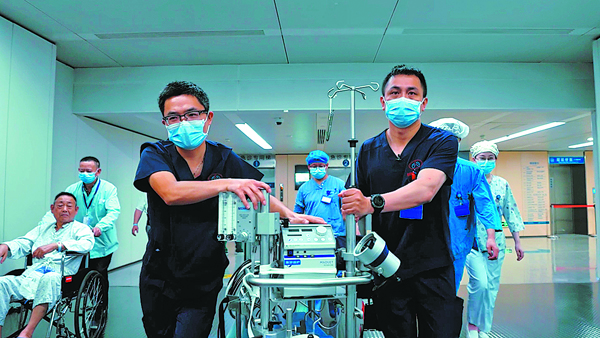
A medical team from Jiangsu Province Hospital in Nanjing heads to another hospital to provide emergency support. [Photo/China Daily]
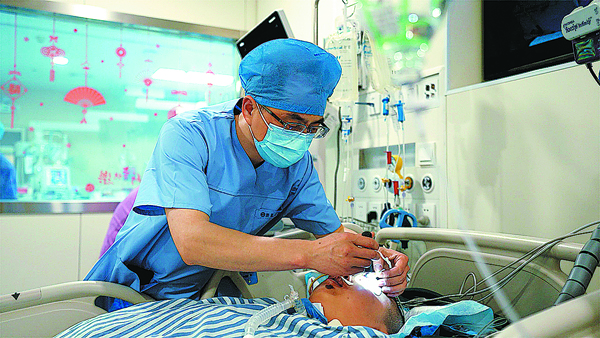
Xu Shanxiang, associate chief physician in the Department of Emergency Medicine at The Second Affiliated Hospital, Zhejiang University School of Medicine, in Hangzhou, observes a patient. [Photo/China Daily]

Doctors at the Zhejiang hospital's Department of Emergency Medicine perform surgery on a patient. [Photo/China Daily]

Director Zhang Jianzhen and the film crew shoot on location. [Photo/China Daily]
 Editor:Cai Xiaohui

