

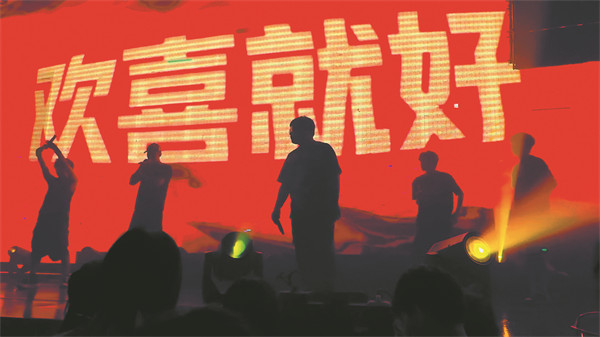
Mean South held their first public performance as a band last October in Putian, Fujian province. [Photo provided to China Daily]
When Zhou Ke was a child, his family lived in the countryside in a home on a winding mountain path. On days when his exam results were poor, his father would not come to pick him up, and Zhou had to walk home alone. Looking up at the overlapping ridgelines ahead, a single question echoed in his mind: Why is the road home so long?
For the people of southern Fujian province, known as the Minnan area, that question seems almost preordained. For centuries, a lack of arable land and proximity to the sea have pushed generations to cross mountains and oceans in search of a better life.
It is from this pursuit that the Hokkien (Minnan regional dialect) rap song Let's Go opens:
The mountains of Minnan stretch on and on.
The heavy rain pours down.
He says go —
Leave the village, earn your own meal.
Cowritten by Zhou and his musical partner, Yi Le, the song drew widespread attention on Douyin last year, garnering more than 4 million views. It later won Best Arrangement at the 2025 World Hokkien Golden Melody Awards in Xiamen, Fujian.
The song also struck a poignant chord among Minnan people who live far from home. In the comments section, listeners often mark their current locations, one writing, "We are like dandelion seeds, scattered wherever the wind carries us."
Minnan communities are concentrated in East China's Fujian, Taiwan and parts of Southeast Asia, yet their reach extends far beyond. Migrating over generations, they have left traces across the globe, carrying their language, memories and cultural bonds.
Zhou and Yi are from Zhangzhou, a quintessential Minnan city, where the dialect still pulses through the streets. Along with four other local young men, they founded the independent rap collective Mean South.
The group includes full-time musicians, university students, a schoolteacher, and an office worker. Their ages range from 20 to 25. Together, they transform everyday Minnan life into lyrics, performing not only in Mandarin but also in their mother tongue.
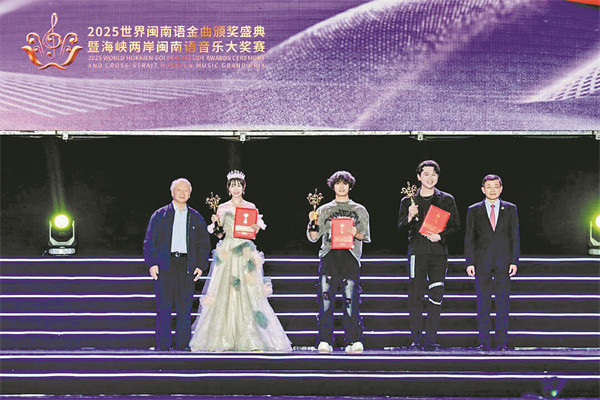
The song Let's Go won Best Arrangement at the 2025 World Hokkien Golden Melody Awards in Xiamen, Fujian province; Zhou Ke is in the center receiving the award. [Photo provided to China Daily]
In the region, one widely known Hokkien song, To Win, You Have to Fight (Ai Pia Jia Eh Ya), sums up a prevailing life philosophy: three parts fate, seven parts hard work.
Zhou grew up immersed in this kind of music, though the influence of this pragmatic culture only became fully clear to him later.
After graduating from university, he returned to Zhangzhou and saw childhood friends constantly leaving home to earn money, returning only a few times a year. They work relentlessly, yet never quite reach the dream of becoming rich. Let's Go is a song about them.
Yi recalls hearing the demo for the first time and sensing its potential."It's based on real stories. You have to write what's true."
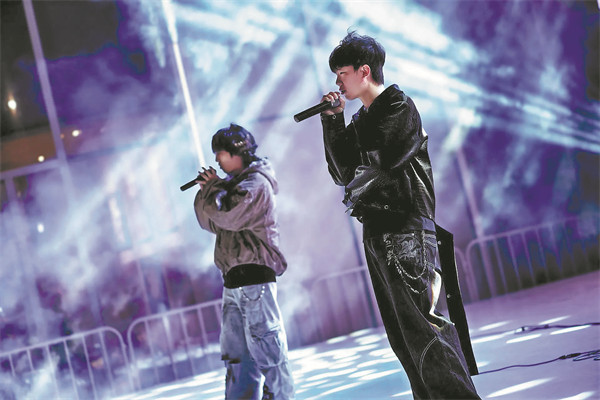
On New Year's Eve 2025, Zhou Ke (left) and Yi Le (right) performed at a shopping mall in Xiamen. [Photo provided to China Daily]
Their first Hokkien rap experiment came four years ago when Zhou overheard a debt collector arguing with a neighbor downstairs. When asked when he would repay the money, the neighbor replied in the local dialect, "I know, I know — money is hard to earn."
Zhou began humming along to the Hokkien phrase "I know". He recorded it and sent it to Yi, who immediately wrote his own verse. Competing over whose lyrics were better, they quickly produced a full song.
"I knew then that this was the right direction," Zhou says.
In 2024, they released a digital Hokkien rap album titled Cu — Hokkien for "home" — with Let's Go as one of its tracks.
"People often leave," Zhou explains. "But when they earn enough, many return home to build houses, even though they spend little time living in them."
However, in a culture that prizes practical achievement, staying home to make rap music is rarely seen as a viable path to success. It is often difficult for families to understand.
Zhou's favorite lyric in Let's Go is:"No matter how much I make, Grandma is happy."
The reality is more complicated."My grandmother actually hopes I'd get a regular job. She thinks making music means I've ruined myself."
While working in an office, Zhou would sneak in music production. His manager noticed and asked why he seemed distracted. Feeling guilty, he eventually quit.
His father told him bluntly, "I thought you were smart, but now you're being stupid."
Music, as Zhou says, gives him pure happiness, especially when he completes a song he's proud of. "It just feels good." Giving up a stable income, however, brought fear and anxiety. For the past three years, he has struggled to make a living as a full-time musician. Last August, seeking a change, he moved from the suburbs to Zhangzhou's urban district and upgraded his music equipment.
Members of Mean South, who had known one another for more than three years, began managing the group project in earnest. They set up a studio and posted short music clips on social media. That was when Let's Go began to gain traction.
With the number of performance opportunities growing, Zhou described his first tangible feeling of success: "Now I can afford to order expensive takeout."
The anxiety, however, remains. These young men often lie awake worrying about the future. Sometimes it is missing self-imposed deadlines. Sometimes it is a lack of inspiration.
"Maybe I need to check the feng shui," Zhou laughs. "I'll check the weather and which way the wind is blowing, then I start writing."
"It's hard to describe the anxiety," says Huang Shisan, another member of Mean South. "When I can't sleep at night, I scroll through my phone — one moment reading philosophy, the next worrying about society."
Huang is a teacher in Xiamen by day and makes music by night. Another member is a university student about to graduate, preparing to take a stable corporate job. They joke that if they ever manage to earn the"1 million RMB" mentioned in one of their other songs, they might consider making music full time.
"For Minnan people, music is often just something for after dinner,"Huang explains. "If it sounds nice, that's enough. But there isn't the same tolerance for young people performing rap as in some other places."
At school, Huang has noticed that many local children no longer speak the dialect. In class, he also teaches in Mandarin. "Rap is a new way of preserving the Hokkien language. It shows people how cool Hokkien can be," he notes.
"Minnan rap isn't limited to the Hokkien language," Zhou adds. The group now hopes to explore it further and bring Minnan culture to a wider audience.
But for now, their audience remains largely Minnan people. Whenever a new Hokkien song is released, those living far from home tune in.
The name Mean South is a phonetic rendering of the standard Chinese phrase for "Minnan youth". The group has its own slogan:
"We are Minnan youth," they say.
"And, in fact, so are you."
 Editor:Cai Xiaohui

