

SONG CHEN/LI XIAOTIAN/TIAN CHI/CHINA DAILY
As the lifeblood of Chinese civilization, Yangtze River culture has endowed the great river societies of the world with a unique Eastern charm and grace.
From the majestic Three Gorges, Yichang, a city in Central China's Hubei province, is nurtured by the mighty Yangtze River, which courses forward and breaks through mountain barriers before slowing its pace on this land. The city stands as a global capital of hydropower, where waters and mountains unite in harmony, blue and green hues intertwine, and humanity blends with the urban landscape.
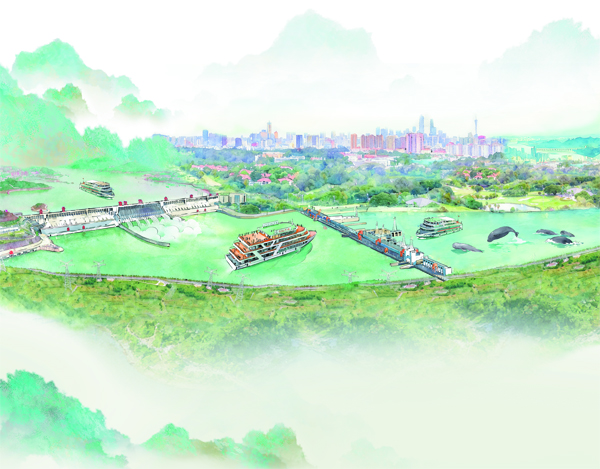
Yichang, a major regional hub connecting the middle and upper reaches of the Yangtze River, is home to both the Gezhouba Dam — known as the first dam on the mighty Yangtze — and the Three Gorges Dam, the world's largest hydropower project. Together, they have enabled this city, covering only 0.2 percent of China's land area, to provide electricity to a vast portion of the country.
The sound that emanates from these dams is not merely the spin of turbines; it is the green heartbeat of the Yangtze, a powerful rhythm of clean, low-carbon energy and an ecological echo that reverberates with a commitment to protect the great river.
The Three Gorges of the Yangtze River form one of the major canyons in the world that can be fully explored by boat. Aboard the Yangtze River Three Gorges 1 — the world's largest electric cruise ship — visitors can tour the Three Gorges Dam, the Gezhouba Dam and the Xiling Gorge. The journey offers views of the nation's monumental engineering feats, the majestic beauty of Xiling Gorge and the vast reservoir cradled by steep cliffs.
In 2025, Yichang welcomed 140 million domestic tourists and more than 400,000 international visitors. They came to experience a poetic voyage that weaves between modern marvels and natural wonders.
Beneath the river's surface, life thrives again. The Yangtze finless porpoise, an indicator species of the river's ecosystem that was once on the verge of disappearing, has made a remarkable comeback. Known as the "smiling angel of the Yangtze", these porpoises now gather in groups, leaping and playing in the waves.
Along the riverfront in Yichang, spotting and photographing the porpoises has become a common occurrence. It is a powerful testament to the ecological restoration along the Yangtze River.
If the dams and the finless porpoises represent Yichang's strength and grace, poetry has long been the soul of its romance. Over 2,300 years ago, Qu Yuan — honored as a world cultural and historical figure — stood by the river and penned the masterpiece Tian Wen (Heavenly Questions), etching a poetic spirit into the heart of Chinese civilization.
Alongside its heritage, Yichang's navel oranges have also journeyed across the world, earning the moniker "diplomats on the Yangtze". Ripened under the unique sunlight and rains of the Three Gorges region, they travel along the golden waterway of the Yangtze, reaching distant shores and adding a bright, sweet note to dining tables globally. This voyage of Yichang's oranges is a reflection of how an inland city embraces the world with openness and shared prosperity.
In Yichang, world-class natural wonders, engineering feats and cultural heritage converge and resonate, shaping a vibrant city and the "green heart" of the Yangtze River. Beating with an authentic rhythm, it sends forth to the world a vision of China's beauty.
 Editor:Cai Xiaohui

