

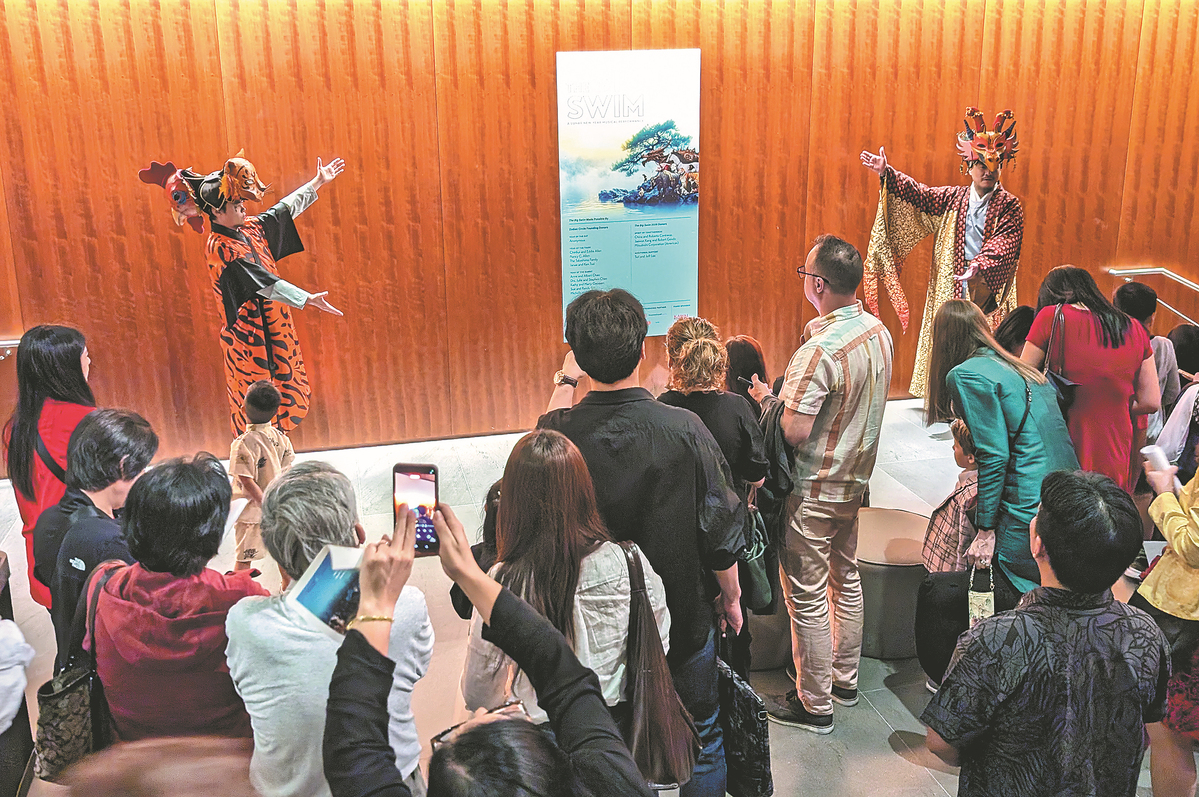
Two opera singers, dressed as a tiger and dragon, welcome the audience to watch The Big Swim on Feb 20 at Asia Society Texas in Houston. [Photo by May Zhou/China Daily]
The Asia Society Texas' theater was packed on Feb 20 for the opening night of The Big Swim, an opera based on the 12 zodiac animals produced specifically for the Chinese New Year.
The Big Swim was developed by the Asia Society Texas Center and the Houston Grand Opera, says Michael Buening, director of the Asia Society Texas' performing arts and culture department.
"We hoped to develop an annual Chinese New Year-themed piece for families," says Buening. "We want it to be the Nutcracker of the Chinese New Year, something that families across Houston can attend every year to celebrate the holiday together."
The classical ballet The Nutcracker is performed in over a hundred US cities during the Christmas season.
The Big Swim premiered in 2024, and this was its third year. From Buening's perspective, the goal of creating a Chinese New Year tradition in Houston has begun to take shape.
"Last year, the second year, we started to see families return. They're excited to see it again. They remembered their favorite animal. We let them meet the actors afterward and take photos. It's turning out how we dreamed it would, and people are excited to see it again," Buening says.
Creating a whole experience around the opera and engaging the audience were key elements, he adds.
A shadow puppet theater was set up to entertain children before the show. People tried their hand at calligraphy, such as writing words related to the New Year.
A tiger and a dragon also entered the grand hall to sing and welcome the audience into the "emperor's palace" to watch the great race portrayed in the opera.
The Big Swim was written by Melisa Tien, a playwright and opera librettist based in New York, with the music composed by Meilina Tsui from Orlando, Florida.
Tien, who grew up immersed in Chinese culture in the US, knew of the 12 zodiac animals since she was a child.
"The emperor gathered the animals for a race. Their order in the zodiac is because they won the race in this specific order," Tien explains.
To make a simple tale into an hour-long opera, Tien had to fill in details and give each animal a distinct personality.
"Chinese culture has attached the monkey to a very specific legendary character. So, I brought some elements of that into the play," Tien says. In the opera, the monkey is a very energetic character, like the famous Monkey King from the classic novel Journey to the West.
Since the monkey, dragon, tiger, and snake are culturally significant, Tien says she subconsciously created a bit more distinction "in terms of how they behaved and interacted with the other characters."
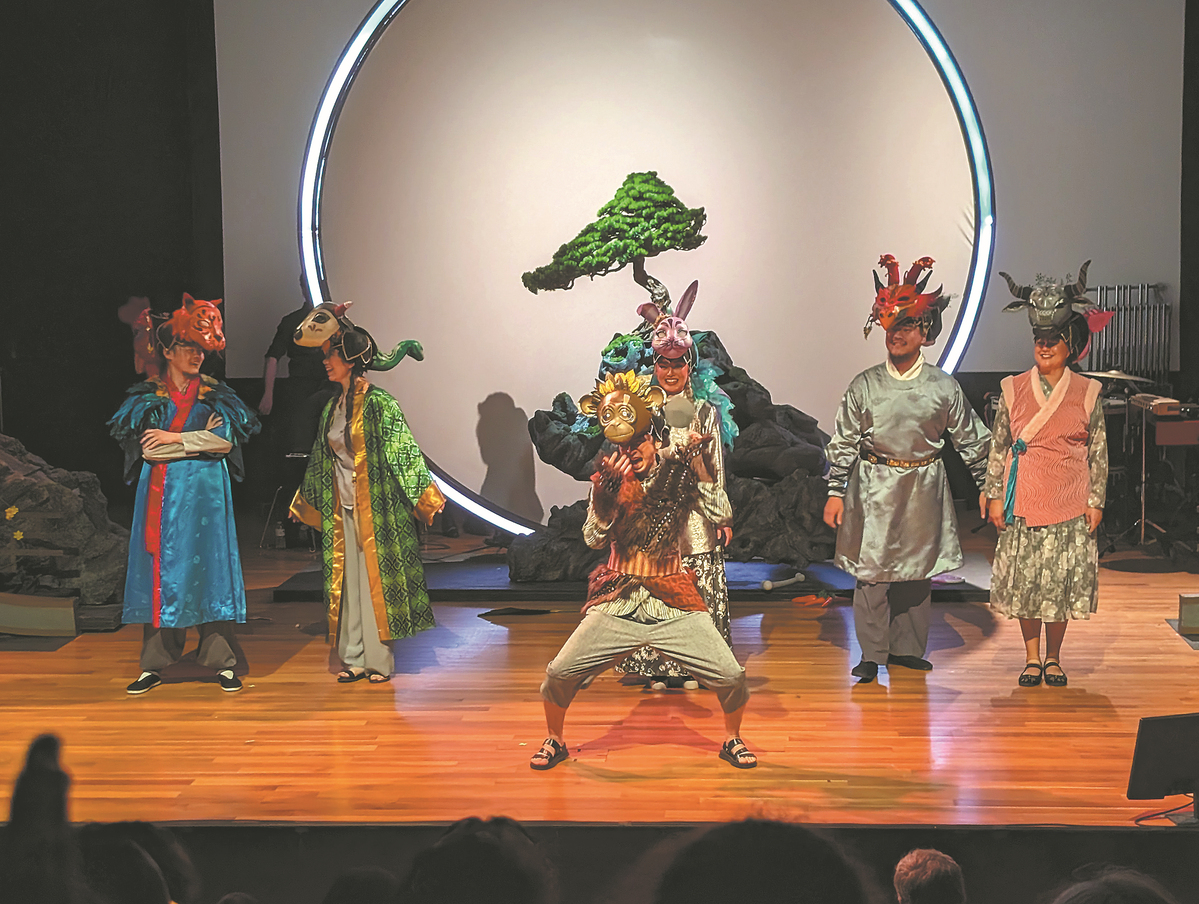
Performers salute the audience after concluding the opera. [Photo by May Zhou/China Daily]
Each opera singer plays two animals by donning a headpiece and switching it between the front and back to represent two different characters.
"I wanted to make sure that for each singer, the two animals they play were quite different so they could play one personality and then a very different one," Tien says.
For example, the sheep and snake are paired, with the former being timid and agreeable and the latter being wily and assertive.
Tien says it was an amazing experience to be invited to write libretti for a story she had known since childhood. "In a sense, it felt like I was being invited to share bits of my culture with the audience."
While the 12 animals initially scheme to win the race, they end up joining hands to overcome a storm to reach the seashore.
Tsui, a composer and pianist, was born in Kazakhstan but grew up in Hong Kong. She is also familiar with the folklore and legends associated with Chinese holidays.
"When I composed the music for The Big Swim, I relied heavily on my knowledge of the zodiac animals' unique personality traits to get ideas for the melodic motifs, harmonic language and orchestration, which helped me create distinct musical personalities for each character," Tsui says.
Peking and Cantonese operas, Gregorian chants, and American and Asian pop music influence her music.
"Both Chinese operatic styles influenced the way I wrote the melodic material in this opera," she says. "For instance, the elegant intonations of Cantonese opera are found in Ox's sentimental aria. The more intense, high-pitched style of Peking opera influenced Rat's highly anxious aria."
When the show ended, each child was given a red packet, or hongbao, a tradition that also enchanted Tsui when she was young.
"My favorite Chinese holiday was always Chinese New Year because of the red packets I would get from the adults! It's like Christmas, but for Chinese kids."
Buening says that the Chinese New Year is becoming more well-known to the public. "Part of our mission is to provide these moments for our communities and to have cross-cultural experiences," he says, adding that the Asia Society Texas has expanded its annual Chinese New Year activities with a variety of performances and activities over two weekends.
 Editor:Cai Xiaohui

