

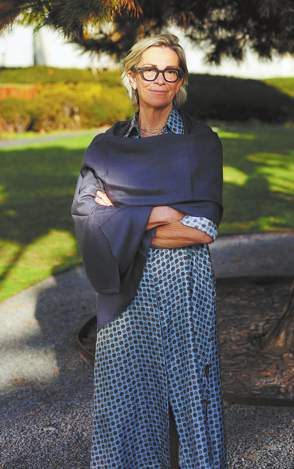
Elena Pantaleoni, who is currently running the historic winery La Stoppa (top right) in Italy, shares her wine story with Chinese guests during a recent event in Beijing. CHINA DAILY
In 1991, when Elena Pantaleoni first walked into La Stoppa, a historic winery founded in the late 1800s and set among the rolling hills of Emilia-Romagna in northern Italy, she felt an immediate responsibility to the land.
"My role was not to impose a new vision; the inspiration came from understanding that this place already possessed everything it needed — character, strength and a clear voice — and my task was simply to align the work with that truth," she recalls.
She dedicated herself to organic farming and eliminated synthetic chemicals, believing that respecting the life of the soil was inseparable from respecting the people connected to it.
To her, wine is culture, ethics and the expression of agricultural labor. "It is not merely a drink but a way of life, built on respect for the land, alignment with the seasons, and the preservation of farming traditions," she says.
Over the decades, Pantaleoni has also witnessed a shift in the winemaking world: women entering the field on their own terms. "Today, women are visible, respected and increasingly influential," she says.

Elena Pantaleoni, who is currently running the historic winery La Stoppa (top right) in Italy, shares her wine story with Chinese guests during a recent event in Beijing. CHINA DAILY
"I believe women bring a form of attentiveness, a capacity to observe details, to sense subtle shifts and to approach the work with patience and depth."
In November, she shared her wines and her story at the one-Michelin-starred Il Ristorante — Niko Romito at Bulgari Hotel Beijing, where Chef Niko Romito paired her wines with his signature dishes for an audience of Chinese wine lovers.
"Winemaking requires listening to the vines, the seasons, the market and the people who work with you. Women tend to cultivate this type of sensitivity, which is not softness, but precision," she says.
For the next generation of female winemakers, her guidance is simple: stay close to the vineyard. "Be patient, resist external pressures, and make choices that remain coherent with the identity of your land. If you understand that wine is a medium through which we can express culture — agricultural, human, ethical — then your work will find its direction."
Pantaleoni sees a shared sensibility between Italy's wine traditions and China's long agricultural heritage. "My Italian terroir is my compass; it teaches me to listen to the land, not command it. This mirrors the profound Chinese respect for natural order and balance. We both guide nature with a patient hand, whether crafting wine or tea, understanding that true quality cannot be rushed."
Her wines, she says, are meant to speak honestly of their origins; something she hopes resonates with Chinese drinkers. "If guests in China can taste that honesty, if they can sense the landscape behind the glass — the agricultural work, the seasons, the long patience of the wine's aging in the cellar — then the wine has fulfilled its purpose."
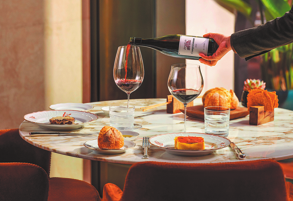
Elena Pantaleoni, who is currently running the historic winery La Stoppa (top right) in Italy, shares her wine story with Chinese guests during a recent event in Beijing. CHINA DAILY
La Stoppa is featured on "The Heroic Women of Organic Wine", a new wine list curated by Bulgari Hotels & Resorts, which highlights 22 women shaping the future of sustainable winemaking.
Spanning terroir from Trentino to Sicily, the list showcases producers whose passion and resilience reflect a new chapter in Italian wine. It is available across all Il Ristorante — Niko Romito locations worldwide.
Nicola Turturro, director of the restaurant and bar at Bulgari Hotel Beijing, sees the initiative as a way to present an unfiltered Italian experience. "The culinary philosophy of Chef Romito, paired with wines such as those from La Stoppa, is not adapted to the location but rather elevated by it to create an authentic experience where Italian heritage and Beijing's serene beauty converse in perfect harmony," he says.
Chinese diners, he notes, are increasingly appreciating boutique and organic labels.
"This trend reflects a broader global movement toward environmental awareness, which resonates well with the values of younger generations," he says.
"I want guests to leave with a deeper admiration for both the exceptional wines of Italy and the contributions of women shaping the wine landscape."
 Editor:Cai Xiaohui

