

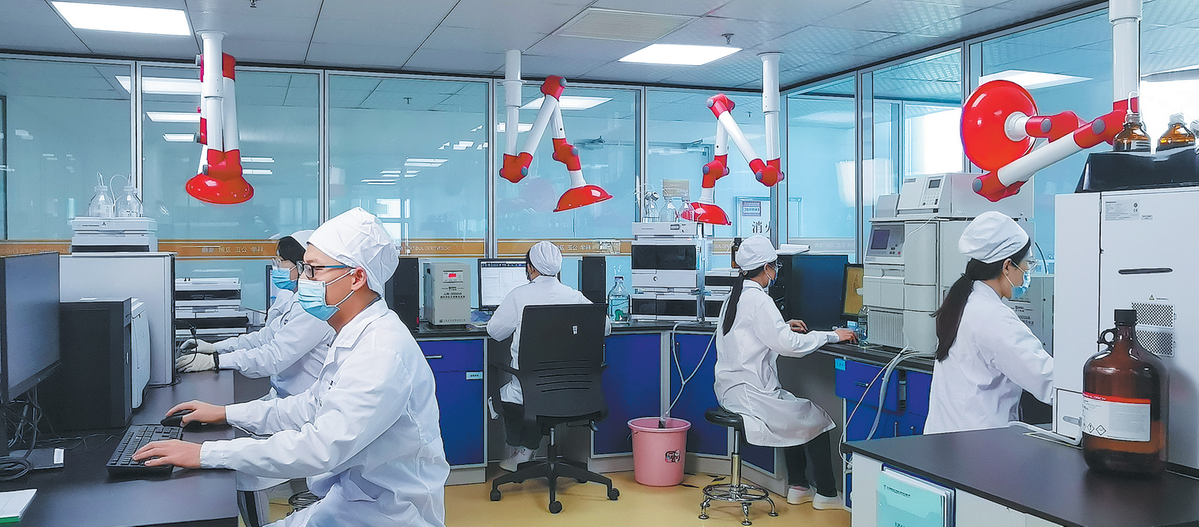
A veterinary drug research and development team is at work at Tianjin Ringpu Bio-Technology Co in Tianjin's Binhai New Area earlier this year. CHINA DAILY
As temperatures rise in North China, April through June marks the peak season for stray animals to give birth. Last week, while admiring blooming crabapple flowers on the streets of Tianjin, Chen Xue not only enjoyed the scenery, but was also surprised to find two newborn kittens.
Chen already has several cats at home. Before bringing the new arrivals back, she opened a pet care app on her phone to find a nearby veterinary clinic for their vaccinations.
Unlike her experience with cat vaccinations several years ago, this time she chose a domestically produced feline trivalent vaccine developed by Tianjin Ringpu Bio-Technology Co, a firm based in Tianjin's Binhai New Area. The veterinarian recommended it, explaining that since 2023, multiple Chinese-made feline trivalent vaccines have received approval from the Ministry of Agriculture and Rural Affairs, breaking the long-standing import monopoly.
"One of the key advantages of domestically produced feline trivalent vaccines is that they are developed using epidemic virus strains isolated locally in China, offering a better match with the virus strains commonly found in domestic cats," said Zhu Yu, a veterinarian at Ringpai Pet Hospital.
"In contrast, imported vaccines often use strains isolated abroad decades ago, which have lower homology with the strains circulating in China, leaving certain gaps in protection," Zhu said. "Domestic feline trivalent vaccines are also cost-effective. While ensuring efficacy, their price is about one-third that of imported products, so more and more pet owners are choosing them."
Chen recalled that five years ago, when she adopted another cat, she faced a severe shortage of imported vaccines during the COVID-19 pandemic era. Prices skyrocketed, and she had to book about a week in advance to secure a dose.
Produced by Zoetis, a US-based animal health company, Miaosanduo was the first and, for a long time, the only approved feline trivalent vaccine in China. Since entering the Chinese market in 2011, it held a monopoly for over a decade.
Zhu recalled that the initial price per dose was around 80 yuan ($11.6). In 2021, a supply chain disruption caused by the suspension of flights from the United States led to the destruction of hundreds of thousands of doses.
"During that period, the price per dose surged to over 200 yuan, and it was difficult to find through regular channels," he said.
At the same time, the number of pet cats in China was growing rapidly. Fu Xubin, vice-president of Ringpu Bio, said that at that time, there were about 50 million pet cats in the country, with approximately 12 million unvaccinated kittens. The risk of infectious diseases was rising, causing widespread anxiety among pet owners.
In 2023, Ringpu Bio's independently developed feline trivalent vaccine received emergency approval from the Ministry of Agriculture and Rural Affairs, becoming the first domestically produced feline trivalent vaccine to hit the market and breaking the foreign monopoly that had lasted more than two decades.
According to a research report by Zheshang Securities, the vaccine was well received after its launch, with 500,000 doses shipped in the first quarter of 2024 and distribution reaching 4,600 pet hospitals nationwide.
Ringpu Bio's ability to lead this wave of import substitution did not happen overnight.
Founded in 1998, the company has achieved several "firsts" in the veterinary drug sector. Early on, it developed China's first heat-stable vaccine and the first inactivated vaccine using ultrafiltration concentration technology. These technical advancements laid a solid foundation for the development of pet vaccines.
In recent years, Ringpu Bio has significantly increased its investment in research and development. It has established six national-level innovation platforms and accumulated 124 certificates for new veterinary drugs and 339 authorized patents.
Last year, the company also received clinical approval for an mRNA vaccine against porcine epidemic diarrhea virus — the world's first clinical approval for an mRNA vaccine for food-producing animals.
Fu said Ringpu Bio's R&D spending represents 8 to 10 percent of its sales, a high ratio within the industry. "We reinvest our profits into R&D, creating a virtuous cycle of sustained investment."
Ringpu Bio is located in a key biopharmaceutical industry cluster in North China. In March, during the 2026 Zhongguancun Forum, the governments of Beijing, Tianjin and Hebei province jointly announced 54 collaborative innovation consortia, five of which are in the biopharmaceutical sector. This regional collaborative ecosystem provides strong support for the company's development.
In the veterinary medicine field, Ringpu Bio has built a complete industry chain from R&D to end services. It handles product R&D and manufacturing. Ringpai Pet Hospital provides pet care services and Zhongrui Supply Chain manages distribution channels.
Fu said this closed-loop model of "products, channels and services" not only accelerates the market penetration of domestically produced pet medical products, but also supports improvements in service quality.
To address the industry-wide challenge of varying skill levels among veterinarians — most of whom only have associate degrees — Ringpai Pet Hospital has established a systematic training system through its chain operations.
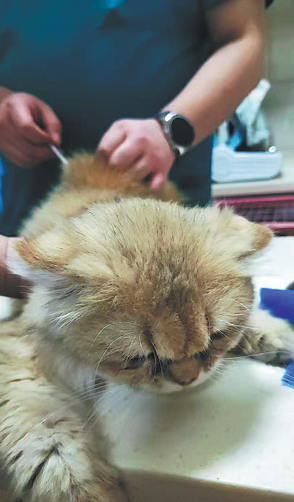
A cat is vaccinated at Ringpai Pet Hospital in Tianjin on Saturday. YAN DONGJIE/CHINA DAILY
The company has about 7,000 veterinarians, with senior experts not only treating patients, but also serving as regional chief specialists and mentors, providing hands-on training to elevate overall clinical standards.
In addition, the company has partnered with institutions such as Fujian Agriculture and Forestry University and Inner Mongolia Agricultural University to jointly build small veterinary teaching hospitals and small veterinary industry colleges.
"Through these collaborations, we hope to get involved in shaping China's small animal medical education system, helping to enhance the clinical capabilities of pet veterinarians at the source," Fu said.
The breakthrough in domestically produced feline trivalent vaccines is just one example of the broader rise of China's pet pharmaceutical industry. According to the 2026 China Pet Industry White Paper, China's urban pet market reached 312 billion yuan last year, with the pet medical market alone growing to 94 billion yuan.
Import substitution is accelerating in the pet drug sector. Of the 52 pet drugs approved by the Ministry of Agriculture and Rural Affairs in 2024, 31 were domestically produced, surpassing the number of imported products for the first time. Of the 60 pet drugs registered last year, 47 were domestically produced.
China's pet market still has significant growth potential, Fu said. Industry data show that less than 20 percent of Chinese households own pets, far below the more than 70 percent penetration rate in Europe and the US.
In late 2024, the Ministry of Commerce included the pet economy in its list of sectors to promote consumption growth, with pet-related tourism and leisure activities emerging as new hot spots. In Tianjin's Wuqing district, a pet carnival is being planned, and in Changli county, Hebei, a pet-themed park is also in the works.
Ringpu Bio is now advancing the development of cutting-edge products including a feline tetravalent mRNA vaccine and a canine tetravalent live vaccine, along with several antiparasitic drugs. At the same time, the company is actively expanding its international presence, establishing a team of more than 40 staff members focused on global markets and exporting products to more than 40 countries participating in the Belt and Road Initiative.
The quality and technological level of the company's products is as good as those of some European generic drug manufacturers, Fu said.
"China accounts for over 70 percent of the global supply of veterinary active pharmaceutical ingredients, and our exports of pharmaceutical formulations and vaccines are also growing rapidly."
Looking ahead, Fu of Ringpu Bio acknowledged both challenges and opportunities.
"Our biggest challenge now is developing original new veterinary drugs. But we are making full efforts to achieve breakthroughs, and in certain areas, we have taken a leading position. Coupled with our advantages in manufacturing processes and cost control, we are confident that China will have a strong voice in the global industrial chain."
Wei Lan contributed to this story.
 Editor:Cai Xiaohui

