

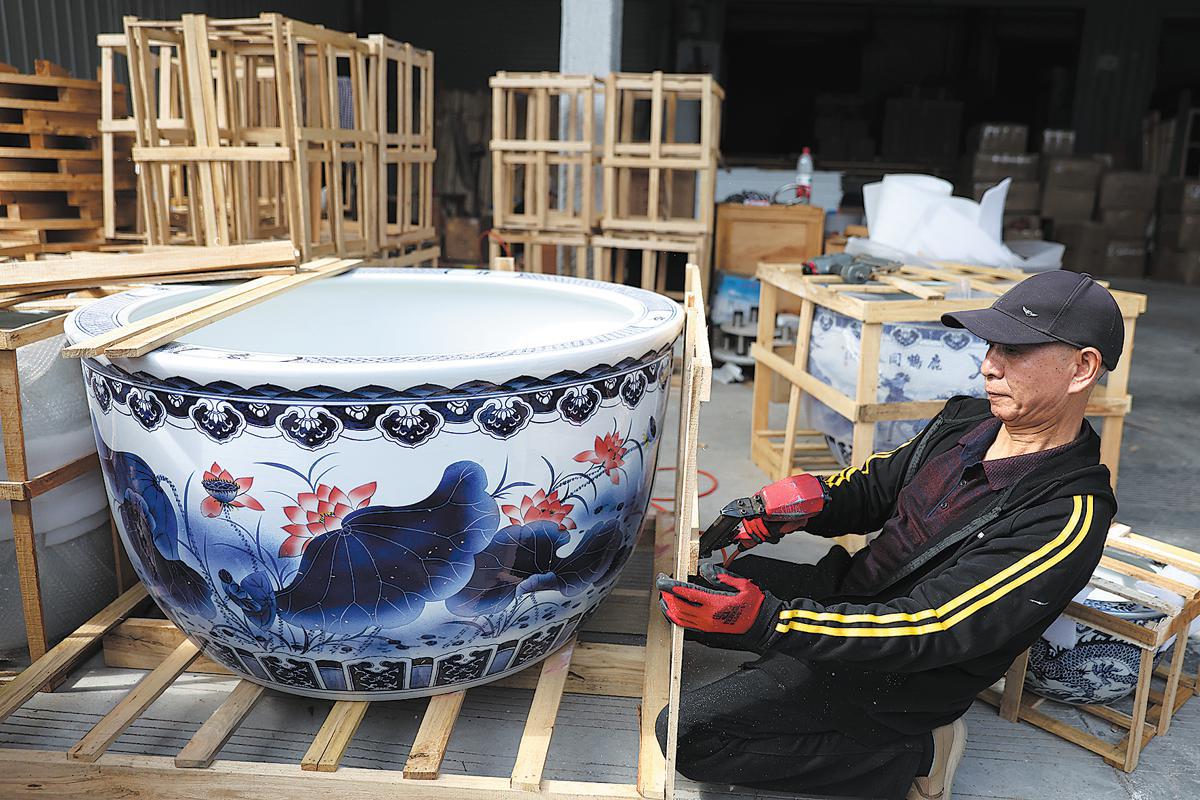
A logistics worker packs a large ceramic water vat with a wooden frame at a logistics center at Jingdezhen's Taobocheng, Jiangxi province, on Nov 7. LIU ZHANKUN/CHINA NEWS SERVICE
Jingdezhen porcelain has long been an important cultural symbol through which the world has come to know China and through which China reaches out to the world. Today, the city is using small "China" to tell the story of big "China", presenting Chinese cultural confidence with greater openness and confidence, said Hu Xuemei, Party secretary of Jingdezhen and a deputy to the 14th National People's Congress.
During a visit to Jingdezhen in 2023, President Xi Jinping stressed that ceramics were a treasure of Chinese culture and an important hallmark of Chinese civilization, and urged the city to make the "thousand-year-old porcelain capital" an even brighter calling card.
Since then, Jingdezhen has taken the construction of the national experimental zone for ceramic culture inheritance and innovation as its overarching framework, working to build a new platform for international cultural exchange, Hu said.
"We have always kept in mind the important instruction to build Jingdezhen into a new platform for international cultural exchange. Using porcelain as a bridge, we are telling the story of China through ceramic culture with greater confidence and openness," she added.
That effort is increasingly visible in the city's engagement with the outside world. Jingdezhen now maintains friendly ties with more than 180 cities in over 70 countries. In 2025, it carried out 16 international cultural exchange events in countries including Turkiye and Italy, covering culture, tourism, trade, sister-city cooperation and people-to-people exchanges.
The city has also built stronger platforms at home. Since 2004, the China Jingdezhen International Ceramic Expo has grown into one of its flagship events. During last year's event, Jingdezhen launched the 1819 Ceramic Carnival, combining exhibitions with float parades, markets and performances that took ceramic culture into the streets and the city's daily life.
The carnival attracted 480,000 visits, generated 570 million yuan ($82 million) in on-site transactions, and drove 2.73 billion yuan in related consumption.
"Ceramics are a world language and a messenger of culture," Hu said. "They play a unique role in promoting mutual understanding and mutual learning among civilizations."
The results have also extended beyond exhibitions. The city's official ceramic flagship stores, after expanding from Dubai to Istanbul, have grown to more than 55 online and offline outlets both at home and abroad, with annual sales revenue reaching 228 million yuan, up 60.56 percent year-on-year.
The openness has also made Jingdezhen a magnet for artists from around the world. French ceramic artist Manon Valle returned to the city for the third time during the 2025 ceramic expo, joining its artist-in-residence community.
She said Jingdezhen offers a rare place where artists from different cultures can meet, work and grow together.
"It's really important to meet people who are not from your own culture. It allows us to grow," Valle said.
Hu stressed that Jingdezhen's growing international appeal is rooted in something deeper: cultural heritage protection.
As one of the world's rare living ceramic heritage complexes, Jingdezhen preserves a complete traditional porcelain-making system linking raw materials, workshops, kiln sites and urban neighborhoods. In recent years, the city has brought 247 protected cultural relic units and heritage zones covering 75 square kilometers under systematic conservation.
More than 420 newly identified immovable cultural relics have been discovered, and the Jingdezhen kiln site complex from the Yuan (1271-1368), Ming (1368-1644) and Qing (1644-1911) dynasties was selected as one of China's major archaeological discoveries in 2024.
"We must protect ceramic culture through inheritance and carry it forward through innovation,"Hu said. In Jingdezhen, protection and opening-up are not contradictory, she added. "They reinforce each other. Rooted in a thousand-year ceramic tradition, the city is continuing to connect with the world while keeping its cultural roots alive."
 Editor:Cai Xiaohui

