

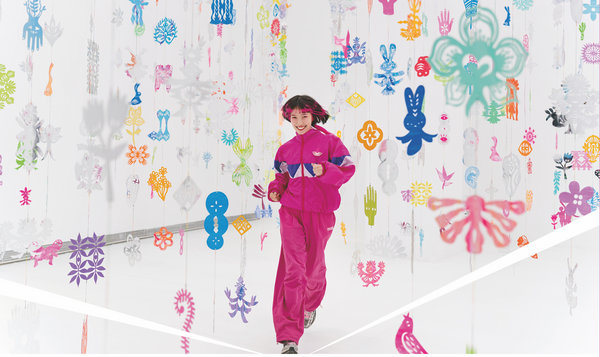
Chen Fenwan holds her solo exhibition, Paper Universe, at A4X Art Center in Chengdu, Sichuan province, in 2024. [Photo provided to China Daily]
Traditional Chinese paper-cutting once lived on windows — red silhouettes blooming during weddings and the Spring Festival. Today, it's turning up in product design and art exhibitions far from home.
Among the artists bringing this thousand-year-old craft into contemporary design is Gen Z creator Chen Fenwan.
Chen's work moves easily between tradition and modern life. She designed a paper-cut-themed gift box for the perfume brand Jo Malone and created smartwatch accessories for Huawei, weaving paper-cut motifs into everything from strap clasps to digital watch faces.
She calls herself "an artist made of paper". "Paper shapes both what I create and how I think," Chen said.
Traditionally, paper-cutting is about what remains: the cut-out parts are discarded, and the intact pattern is what people keep.
Chen challenges this logic. "Can the hollow itself become the main subject?" she asked.
This vision shaped her exhibition, Paper Cutting, displayed on Paris's Champs-Elysees during the 2024 Summer Olympics. Chen imagines a world where paper is not just a craft material but the foundation of an entire civilization. Her installation presents everything — from trees to architecture — in symmetrical paper-cut forms, suggesting a society built on restraint and balance.
"What matters to me is the logic of subtraction," she said. "The interplay of solid and void in paper-cutting reflects Eastern philosophies of coexistence."
To Chen's surprise, when she introduced her work to Thomas Bach, president of the International Olympic Committee, he immediately brought up yin and yang.
"That moment made me realize it isn't just an Eastern concept," Chen said. "It's a universal language of balance."
Another signature of Chen's work is her bold use of pink. "Pink was once off-limits to me," she admitted. "I used to think it symbolized the 'good girl' stereotype."
The turning point came in 2016 when Chen began to see pink differently — as the natural hue of Asian skin, a color of life itself. Since then, she has fully embraced it. "My early pinks were soft," she said. "Now they are fluorescent and sharp."
For Chen, color is a way of speaking to her audience — and the shifting shades of pink mirror her growing courage to break free from old ideas.
In her view, the modern vitality of paper-cutting does not lie in color, form, or technique, but in the contemporary spirit and ideas it carries. "I want my works to draw attention, but more importantly, to make people think about the stories and realities they reflect," she said.
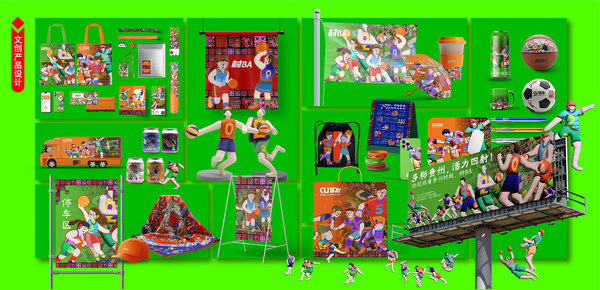
Wang Xi incorporates Miao embroidery into the cultural products of Village BA and cunchao. [Photo provided to China Daily]
Culture in play
Young designer Wang Xi, now an associate professor at Sichuan Fine Arts Institute, has led a creative team to fuse Guizhou's intangible cultural heritage — Miao embroidery — with two of the province's grassroots sports sensations: the Village Basketball Association (Village BA), a local basketball tournament, and its soccer counterpart, the Village Super League, or cunchao.
This cross-disciplinary approach led the team to design cheerleading costumes, cultural merchandise, and other creations inspired by Miao embroidery. Their work earned the 2025 Red Dot Design Award — one of the world's most prestigious design honors.
The idea for this fusion emerged during the team's field visits to Guizhou. At the cunchao field and under the Village BA hoops, they watched the Miao people's Lusheng dance move in rhythm with the roar of the crowd, while elders in traditional dress held children in their arms as they cheered.
"Rural sports were not isolated competitions but natural vessels for ethnic culture," Wang said, adding that as a living emblem of Guizhou's intangible heritage, Miao embroidery captures that spirit in its most delicate form.
Then came a flash of insight. The team noticed how the players' running paths echoed the curved rhythms of embroidery stitches, and how their leaps and shots mirrored the tension of pulled thread.
"Both come from the same origin,"Wang explained. "Embroidery shows the vitality of the hands while rural sports express the vitality of the land."
During the design process, the creation of cheerleader uniforms left the strongest impression. The team deconstructed traditional embroidery motifs, transforming the granular texture of hand stitching into dotted patterns, and the winding motion of thread into dynamic, flowing lines. They also replaced the embroidery's traditional deep reds and indigos with bright yellows and oranges — preserving cultural identity while appealing to younger audiences.
Explaining why the project won the Red Dot Award, Wang said it succeeded by balancing cultural authenticity and emotional resonance.
"Global designers have seen too many decorative 'Oriental elements'," he noted."We didn't simply paste Miao patterns onto jerseys. Instead, we turned embroidery into the players' strength and the energy of competition — giving tradition a vivid emotional expression and showing that intangible heritage is not just a relic, but a language that conveys universal feelings."
By involving local embroiderers, the team also helped turn heritage from a display piece into a living industry, combining cultural preservation with social value — a quality that clearly impressed the judges.
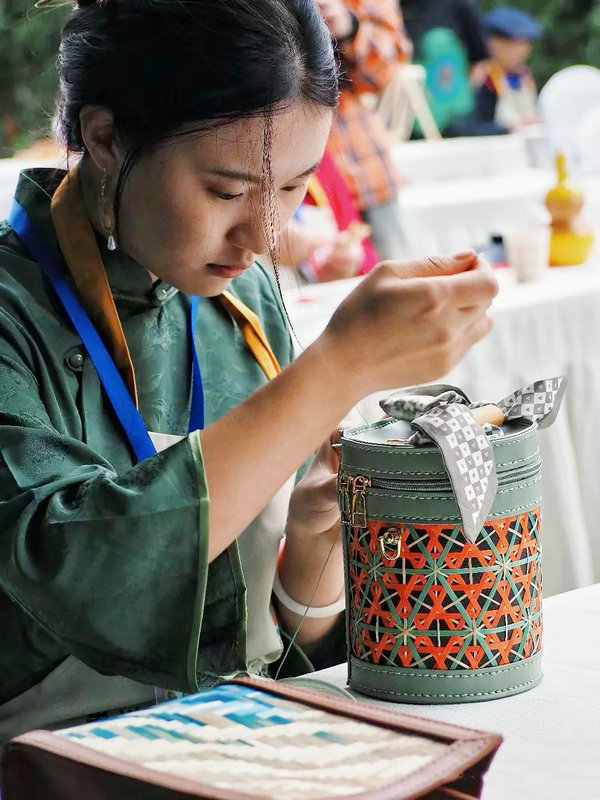
Zhang Dingjuan creates a handbag using Daoming bamboo weaving craftsmanship. [Photo provided to China Daily]
Heritage in style
In the Mid-Autumn Festival season of 2025, specialty coffee brand M Stand partnered with Zhang Dingjuan, a 30-year-old inheritor of Daoming bamboo weaving. The craft, recognized as national intangible cultural heritage, comes from Daoming town in Chongzhou, Sichuan province, with its roots tracing back to the Qin Dynasty (221-206 BC).
"When we collaborate with a brand, we always look for shared elements between their identity and bamboo weaving,"Zhang explained. "With M Stand, we focused on patterns and simplicity. The Z-shaped weave echoes the 'M' in their logo, and the neutral colors match their clean, minimalist style."
Zhang grew up watching her grandfather, a bamboo craftsman, weave baskets at local markets. After studying product design at university, she wanted to further explore the craft. She traveled to Daoming to train under Zhao Sijin, the master inheritor of Daoming bamboo weaving.
"At first, he didn't think I was serious," she laughed. "He told me, 'Come learn whenever you like.' But I showed up every morning at 8."
One of the most commonly used materials in Daoming weaving is Yinshan cizhu bamboo, usually harvested at two to three years old. With long joints, thin walls, and strong elasticity, it produces durable, long-lasting products. But the process is painstaking, involving dozens of steps — scraping, splitting, slicing, thinning, and stretching the fibers.
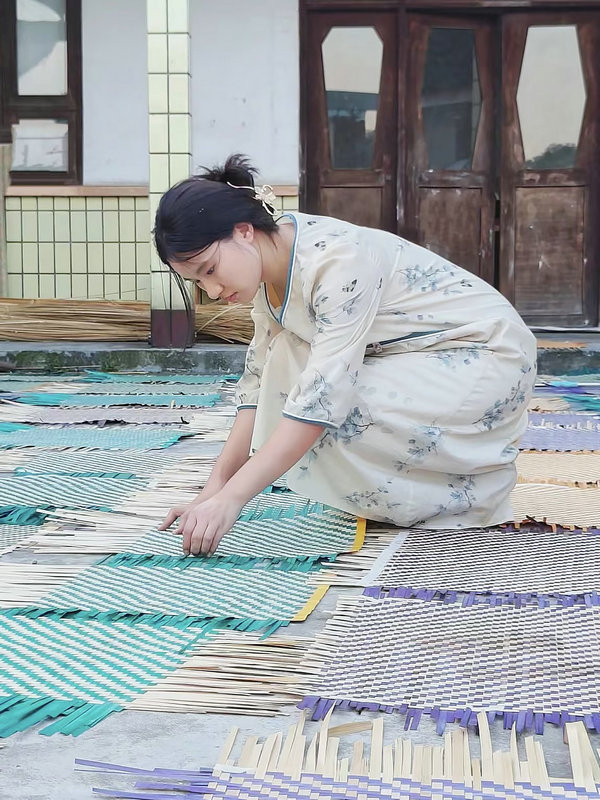
Zhang enjoys spending time quietly at home making bamboo-woven products. [Photo provided to China Daily]
For Zhang, the hardest part was handling the heavy splitting knife. Splitting requires gripping the bamboo with one hand while pressing down on the blade with the other, especially at the nodes.
Cuts were frequent, leaving pale scars behind. "The strips are sharp, and fibers sometimes slipped under my nails," she said. "It hurt, but I kept practicing."
Today, Zhang has expanded the craft beyond traditional baskets into earrings, bracelets, phone cases, designer bags, and even car seat backs. A gourd-shaped bookmark she designed brought in more than 100,000 yuan ($14,325.69) in a single month. Last year, she launched her own brand and began taking custom orders.
"It took a long time to get here," she said. "I spent seven years learning in Daoming. From making small pieces to taking on complex, customized projects, it's been a long journey."
 Editor:Cai Xiaohui

