

Recently, the trend of decorating bags with charms has taken off among young consumers. On social media, topics such as "bag charms" and "bag buddies" have attracted hundreds of millions of views, with users actively sharing their styling ideas, creative combinations, and DIY tutorials.
Statistics show that in the first half of this year, sales of plush bag charms on one e-commerce platform jumped 164 percent year on year. Meanwhile, Chinese pop culture brand Pop Mart reported an astonishing 1,276.2 percent surge in revenue from plush bag charms.
Affordability is one reason young people are drawn to bag charms. Priced under 100 yuan (about $14), they add a touch of fun and freshness to everyday life.
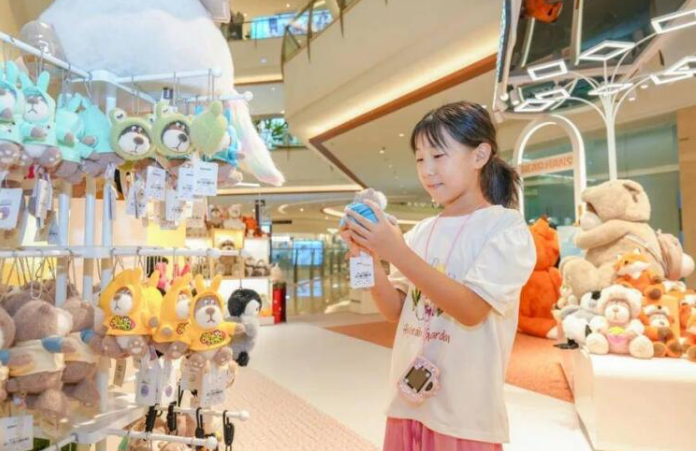
A girl selects bag charms at the BearHans store in MixC Mall, Hefei, east China's Anhui Province. (Photo/People's Daily Online)
Yang, a young professional born after 1995 who works at an internet company in Beijing, sees bag charms as a personal statement. He decorates his bag with two charms—one reflecting the creative cultural elements of his hometown, Datong in north China's Shanxi Province, and the other inspired by the Chinese animated film "Ne Zha."
For many people, bag charms are more than just accessories—they express personal taste and interests, and even serve as emotional companions.
Xiaomeng, an anime fan, said, "Bag charms create a connection between me and my favorite characters and stories." Whenever she sees them, she's reminded of scenes and lines from the shows, which gives her a sense of encouragement and companionship.
Wang Yan, a professor at the School of Psychology and Cognitive Science at East China Normal University, noted that young people don't buy bag charms for their practical use. "They see them as sources of emotional comfort. This kind of emotional spending is a way to relieve stress."
Bag charms also satisfy young people's need to connect with others. A woman surnamed Wang said she's even made friends with others who share her love for bag charms.
Bag charms are increasingly serving as a social icebreaker among young people. On social media, hashtags like "bag charm buddies" and "bag charm friendships" are gaining traction, as young people share photos, styling tips, and other posts that help them continue interest-based socializing in virtual spaces.
Li Yongjian, a researcher at the National Academy of Economic Strategy under the Chinese Academy of Social Sciences, noted that bag charms allow for far more creative freedom than the bags themselves. They offer a stronger outlet for personal expression, helping people find others who share similar emotional needs and values.
At the cultural and creative store of the Hubei Provincial Museum in Wuhan, central China's Hubei Province, Suan Niao (Garlic Bird), an IP featuring a small bird with garlic on its head, has become a bestseller. The character's name is a play of a high-frequency expression in the daily life of Wuhan locals—"suan le" (let it be), which, in the local language, sounds like "Suan Niao," nodding to a relaxed and easy-going attitude.
Building on this IP, the museum incorporated design elements from historical artifacts such as the Sword of Goujian and the Spear of Fuchai to launch a co-branded "Suan Niao" series.
Small bag charms are driving the growth of a vibrant new industry. In Dongguan, south China's Guangdong Province, the entire ecosystem—from design and R&D to manufacturing, IP licensing, and distribution—has become increasingly mature, gradually forming a complete industrial chain.
Dongguan is a toy export hub, home to more than 4,000 toy manufacturers and nearly 1,500 supporting enterprises.
 Editor:Cai Xiaohui

